Amber hunting on the Polish Baltic coast: where and when?
The Gulf of Gdańsk and the Vistula Spit give up the most amber. The best time is from autumn to spring, a few hours after a storm, with a wind that hits your stretch of shore as close to head-on as possible, because that direction is different on every stretch of the coast.
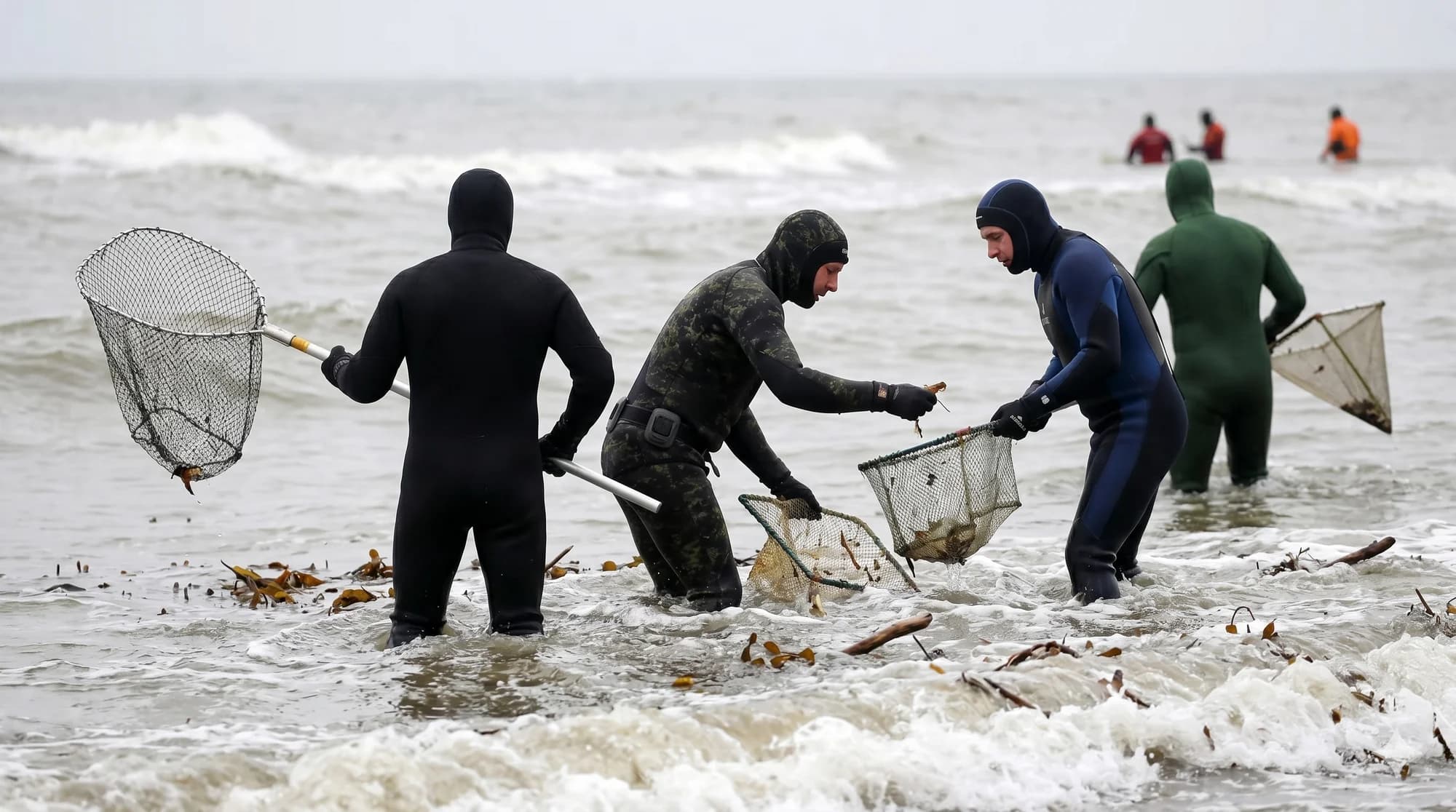
It is no secret among collectors that the Polish Baltic coast yields considerably more amber than the German one. The reason is geology: Poland lies closer to the centre of the Baltic deposits, the Eocene amber delta that stretches from the Sambia Peninsula to Chłapowo near Władysławowo, so the local secondary deposits, partly reworked by glaciers, lie more densely here. It is from these that the sea throws material onto the beach during storms. But this wealth is not spread evenly, neither along the coast nor through the year. There are weak stretches and very good ones, and which of them is delivering at any given time is decided above all by the wind.
Anyone who has learned on their home beach which wind makes the walk to the shore worthwhile, and comes to the Polish coast for the first time with that knowledge, is often disappointed: the storm was strong, the strandline fresh, and yet there is nothing in the wood or the weed. That is rarely the amber’s fault. It is the coastline’s.
Whether amber reaches the beach depends mainly on two things: the strength of the storm and its direction. Strength is the precondition; without heavy seas nothing moves on the seabed. But what makes the difference between beaches is the direction. And the right direction is not the same everywhere.
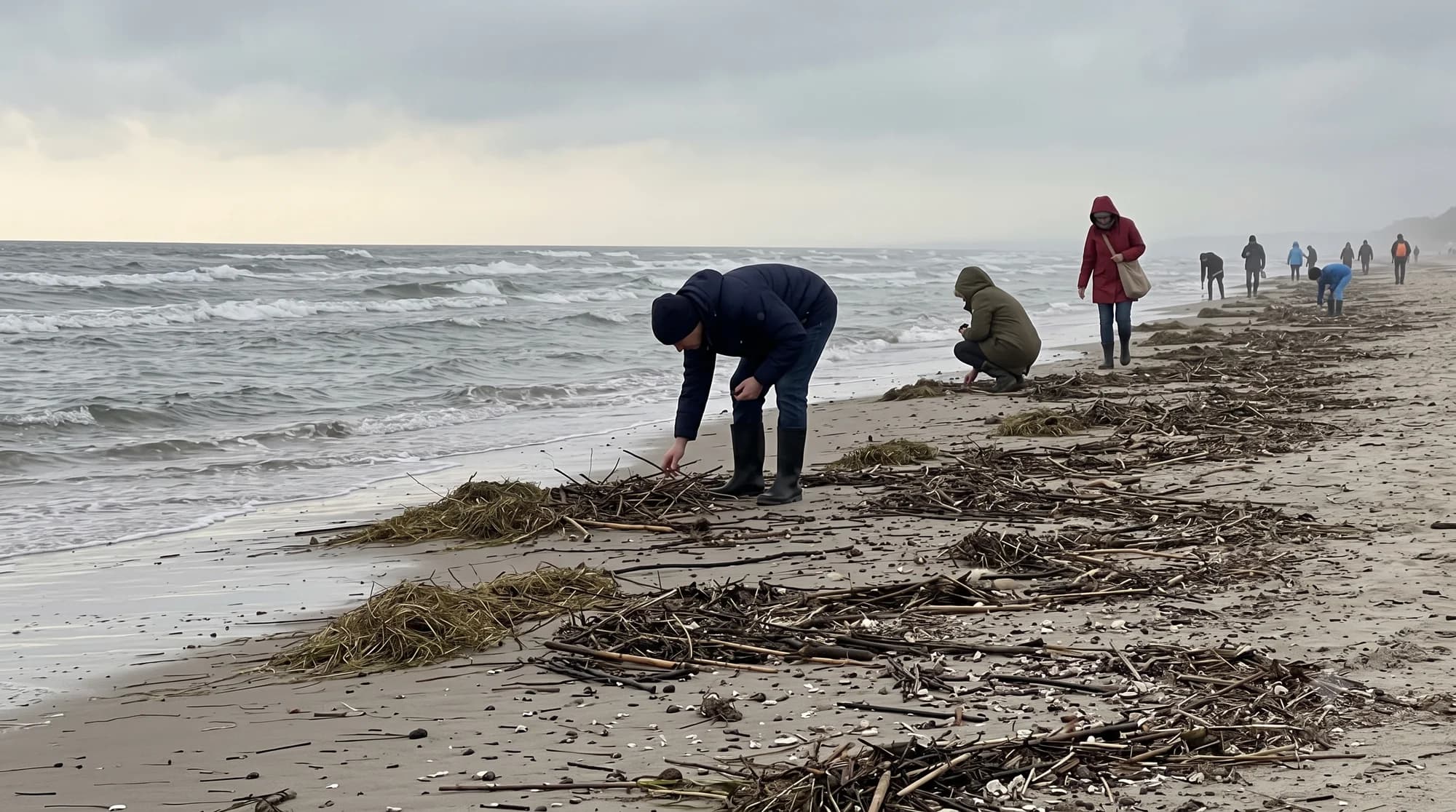
Which wind brings amber? One rule for the whole coast
Amber lies on the seabed. At 1.05 to 1.10 g/cm³ it is denser than Baltic seawater at around 1.005 g/cm³, so it does not float, not even in cold winter water. What moves it is wave energy at the seabed. And that is strongest where the wind blows onshore, meaning it hits the coastline as close to head-on as possible.
From this follows something unspectacular that makes all the difference in practice: the productive wind sector turns with the coastline. Anyone who compares a few beaches on the German coast knows the principle: on the north beach at Prerow, which faces north, what counts is an onshore wind from north to north-east, while on the coast of Usedom it is the north-east.
So what is new about Poland is not the principle but the scale: over roughly 500 kilometres the coast changes direction several times, and with it the wind that brings amber.
Roughly from west to east:
• the open western coast (Kołobrzeg, Ustka, Łeba): NW to N
• the outer side of the Hel Peninsula (Władysławowo to Hel): NE
• the inner Gulf of Gdańsk (Sopot, Gdynia): E to NE
• the southern shore of the gulf (Stogi, Sobieszewo Island): NE to N
• the Vistula Spit (Mikoszewo, Jantar, Stegna, Sztutowo): N, turning towards NW at the eastern end near Krynica Morska and Piaski
The same north wind that brings material to the Vistula Spit runs parallel to the shore at Sopot and Gdynia, where it tends to take things away rather than bring them. And the outer side of the Hel Peninsula has its own trap: in a south or west wind the peninsula casts a wave shadow over its own seaward side, and any search there is pointless, however hard it blows.
Where to find amber: area by area
The western coast: the quickest way in. Świnoujście lies on the Polish part of Usedom, just across the border, which for many German collectors makes the Polish coast closer than their own favourite beach. Further east, Kołobrzeg is the most convenient base: around twelve kilometres of beach within the town limits, plus its own small amber museum. If you want peace and quiet, stick to the eastern stretches towards Podczele and Bagicz rather than the town beach.
The middle coast: less competition. Ustka and Łeba are the most rewarding spots between Kołobrzeg and the Gulf of Gdańsk. Both sit at a river mouth, which matters in practice: in Ustka the Słupia splits the beach into a western and an eastern section, and in Łeba the river of the same name separates the west beach from the east beach. After a storm it pays to walk both sides; which one was more productive depends on the direction of the last wind.
A curiosity of this stretch is Jarosławiec, between Darłowo and Ustka: the unusually wide, artificially built-up beach created there a few years ago, known locally simply as “Dubai”, is something like the most reliable consolation prize on the whole coast. Very fine amber turns up there almost always, largely regardless of wind and weather. If you have children with you or simply don’t want to go home empty-handed, you will rarely be disappointed, unless someone got there before you that morning.
The Hel Peninsula: unpredictable but rewarding. From Władysławowo to Hel, the outer side of the Hel Peninsula faces the open sea for a good 35 kilometres. Rougher surf and less predictable, but on good days there is very little competition, especially in winter, when the peninsula is practically empty. Władysławowo has much easier access; Hel has the lonelier beach.
This brings us to the core area: the Gulf of Gdańsk and the Vistula Spit are the richest stretches of the Polish coast for amber.
The Gulf of Gdańsk: close to the city. Sopot and Gdynia can be reached by commuter train, and in summer they are hopeless, because the beach is combed by hundreds of people before sunrise. In winter and early spring they are a real option. The beach at Stogi, on the edge of Gdańsk, is the widest in Poland at more than 132 metres; until the late 1980s illegal amber diggers, the bursztyniarze, washed amber out of the ground here with pumps and left dangerous holes behind in which it was easy to break a leg. Today nothing remains of that but the story and a very good beach. Sobieszewo Island is one of the best places on the entire Polish coast, and at the same time the quietest address on the gulf: eleven kilometres of largely wild beach, plus protected-area status that keeps visitor numbers low. A productive window and little searching pressure at once is a rare combination on this coast.
The Vistula Spit: the classic ground. The stretch from Mikoszewo via Stegna and Jantar to Krynica Morska is regarded as the most productive amber area in Poland. This is where the records fall, both for the largest single pieces and for the largest daily hauls. But this is also where the competition is fiercest: nowhere else do so many people search. Jantar carries amber in its name (jantar is the old Polish word for it), and since 1998 it has hosted the final of the World Amber Fishing Championship, organised by the municipality of Stegna, with qualifying rounds in July. Mikoszewo at the western end, right by the Vistula cut dug in 1891–1895, is noticeably quieter than its neighbours with comparable yields; a seasonal ferry crosses over from Gdańsk-Świbno. At the eastern end, Krynica Morska and Piaski are the smallest and least-searched spots, with the window turned towards the NW mentioned above.
When to look for amber: the season
The season runs from autumn to spring. Poland’s weather service, IMGW, records around 20 to 25 storm days a year on the coast, with peaks in November, January and March, and most usable windows simply fall in those months.
In summer the sea washes up amber much less often, but it does happen. July 2026 showed exactly that: after two summer storms, on 8 July and around 22 July, collectors on the Vistula Spit reported daily hauls of a kilogram and more for several days in the middle of the tourist season. So what matters is less the calendar than the weather window.
You search after the storm, not during it. The usable window opens when the onshore wind eases and the waves die down but the fresh material is still lying there, typically a few hours after the peak. More on season and timing in When to find amber.
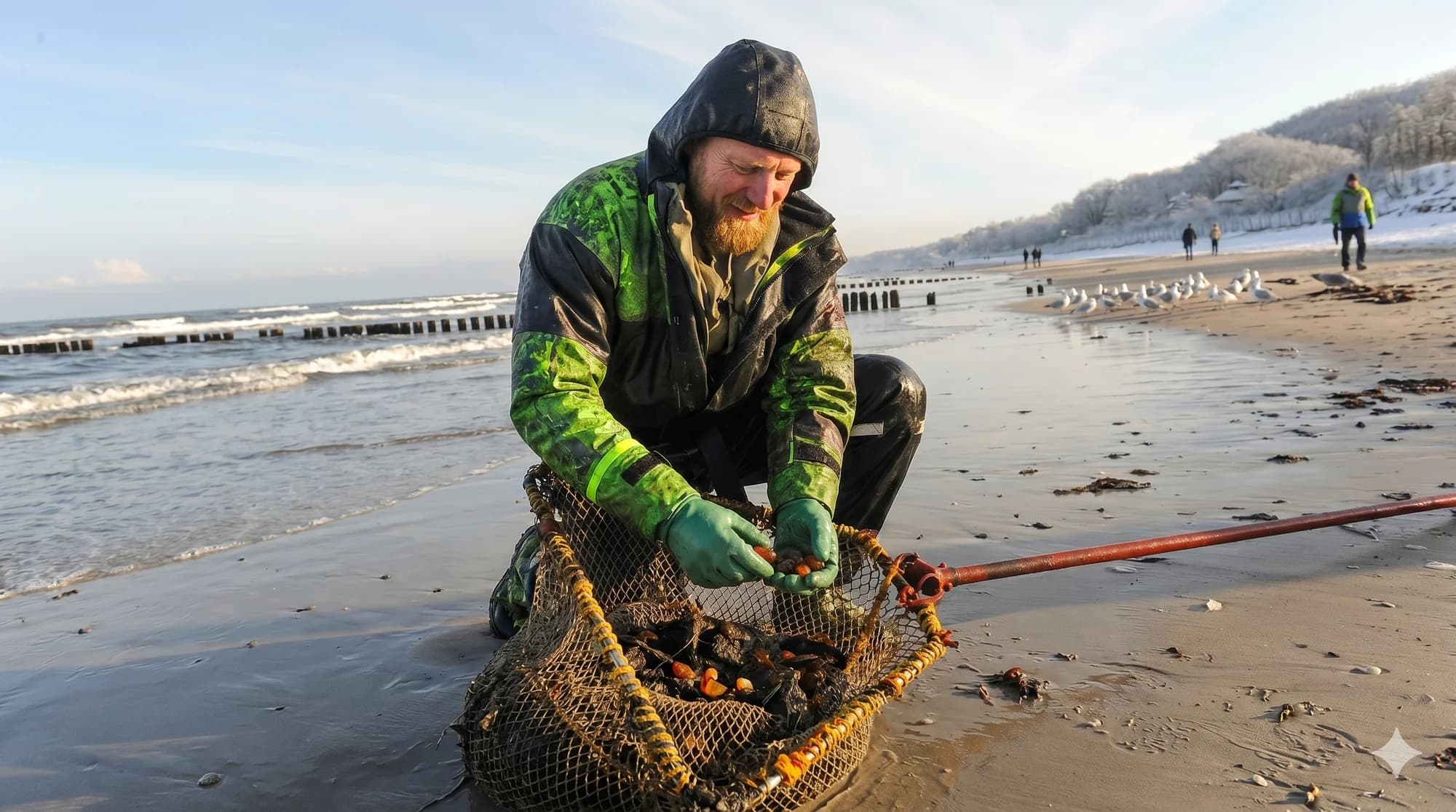
How to look for amber on the beach
You search the strandline: the line of seaweed, bits of wood and other debris that the sea leaves on the beach as it retreats. Amber is denser than water, but at around 1.07 g/cm³ it is far lighter than quartz sand at 2.65 g/cm³. Once the waves have lifted it off the seabed, it is subject to the same hydraulic sorting as wood, peat and seaweed, and ends up in the same line as them. The best sign is therefore the small black sticks, known on German beaches as Bernsteinholz (“amber wood”): where they lie in dense bands, the amber lies too. A strandline full of shells, on the other hand, is usually a bad sign. Shells belong to a different, heavier sorting class, and where the sea drops shells it rarely drops amber. Clean sand next to it is a waste of time anyway. How to work the strandline step by step: Amber after a storm.
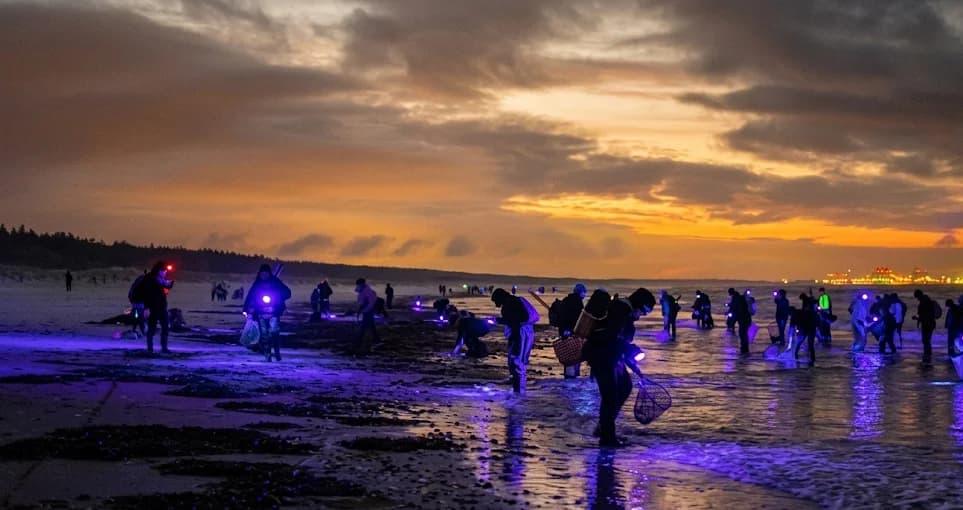
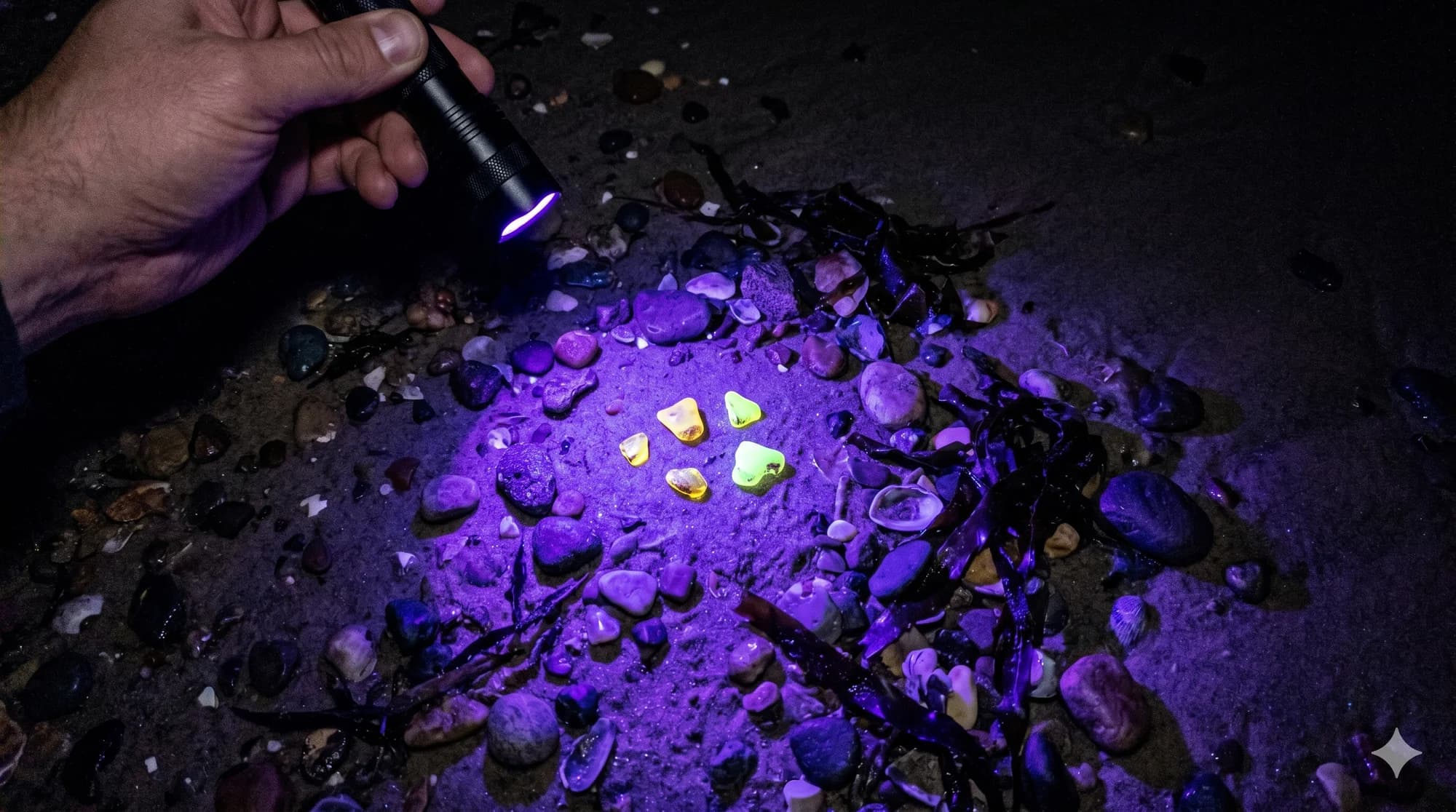
Two tools are worth having. A UV torch makes night searching efficient: amber fluoresces blue-green and stands out from the gravel at once, and night searching is more common on Polish beaches than in Germany. The wavelength matters here: on the beach, and above all when fishing from the water, 420 nm works best, because seawater quickly swallows short-wave light. The widely sold 365 nm torches unfortunately perform much worse (especially in water), and a 420 nm torch is better bought from a specialist. The second popular tool is the net, in Polish kaszorek: a long-handled net used in waders right in the surf zone. On good days whole lines of collectors stand in the water with them on the Vistula Spit. When buying one, it is worth choosing a dedicated stainless-steel amber net with a strong mesh: ordinary fishing nets don’t hold up. They break, and the mesh tears under the weight of what you pull out of the water. More on gear: Amber-hunting gear.
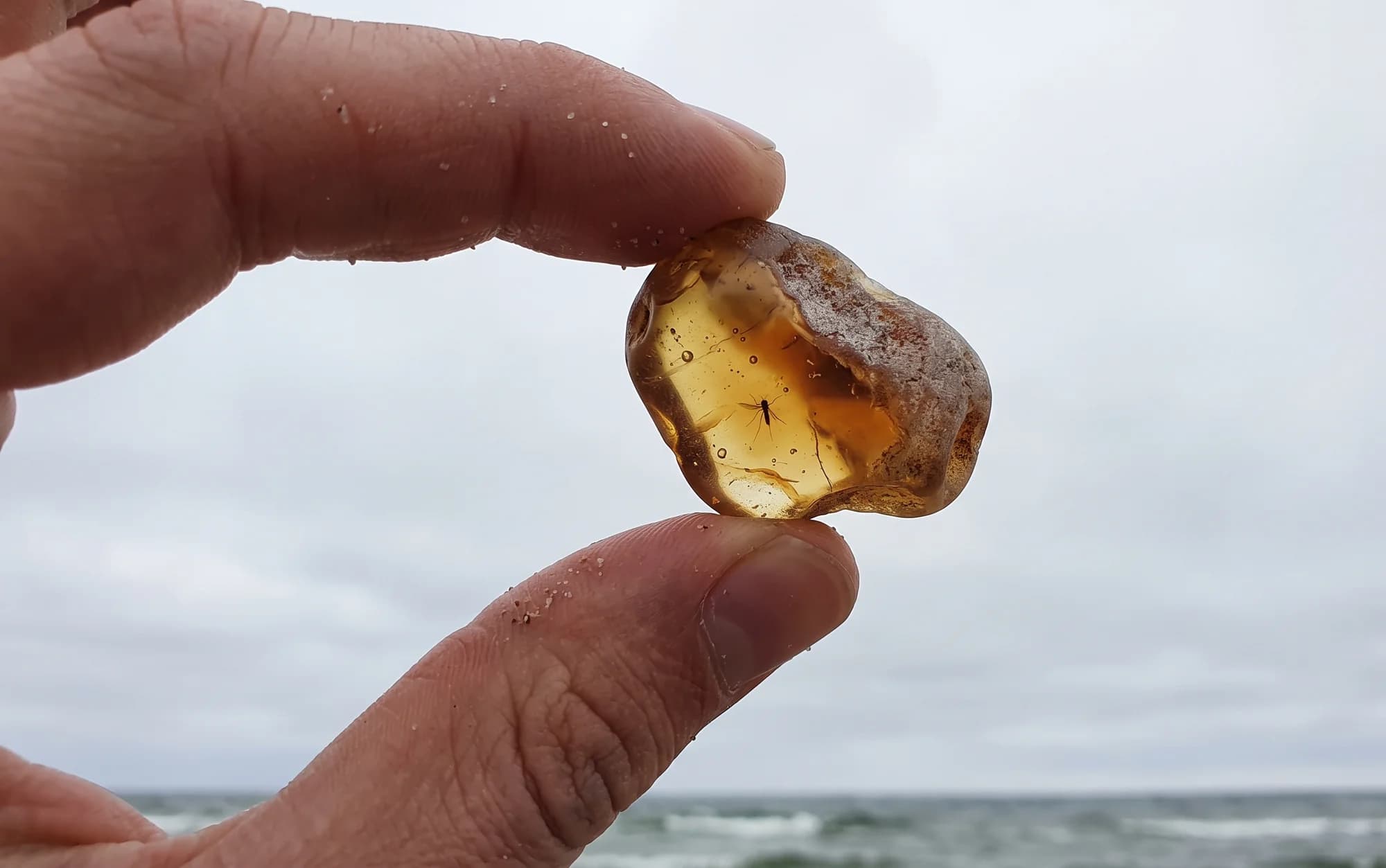
Inclusions in amber
Pieces with insect or plant inclusions turn up regularly on the Polish coast too. Baltic amber is more than 40 million years old, fossil resin from the conifer forests of the Palaeogene, and its deposits have been reworked by glaciers several times since. At home, after the first clean, it is worth holding every piece up to the light to see whether it holds just such an inclusion.
Warning: white phosphorus
One point that has to be taken seriously, however much fun collecting is. All along the southern Baltic, white phosphorus from old munitions can wash up, and it looks deceptively like amber. It ignites by itself as it dries and burns at over 1,000 °C. So never put finds loose in your trouser pocket; use a metal tin or a sieve instead, and if in doubt, leave it where it is. This is not a theoretical risk; it has repeatedly caused serious burns on the Baltic. How to tell the two apart: How to identify amber.
Is collecting amber legal in Poland?
Picking up amber that the sea has thrown onto the beach is traditional practice on the Polish coast and is generally treated as permitted for private individuals. Active extraction is a different matter: according to the Polish amber association (Stowarzyszenie Bursztynników w Polsce), neither fishing nets nor pumps nor diving equipment may be used for it, and washing out the ground with pumps counts as illegal extraction. A hand net in the surf is not affected. Protected areas have additional rules, for example the Słowiński National Park near Łeba and the Mewia Łacha reserve at the mouth of the Vistula; check the relevant regulations there before you go.
In short: storm plus direction
The most honest summary is an uncomfortable one: a storm on its own tells you little. Only a storm and the direction that suits the stretch of coast in question make a window, and even then it remains a probability, not a certainty. Anyone who has driven home from the Vistula Spit empty-handed after a perfect north-easterly storm knows this.
This is exactly the combination we calculate for the Baltic coast and show on the amber forecast map. There is no guarantee of finds there, any more than anywhere else; what it does is forecast the days on which the trip is worth making at all.
Good luck and good finds on the Polish coast!
See also
Frequently asked questions
Where in Poland is the best chance of finding amber?
Which wind brings amber to the Polish coast?
When is the best time to look for amber in Poland?
Is collecting amber on Polish beaches allowed?
We’ll tell you when amber starts washing up
Leave your email and we’ll let you know when conditions on the Baltic coast point to a good day for amber. Now and then we’ll add some AmberMap news.
See when to go to the beach
The AmberMap map shows the current amber forecast for the Baltic coast.
Open the mapOr browse beaches with a dedicated forecast.