How to identify amber
On the beach, amber is easily confused with a pebble, glass or plastic — and, in the worst case, with dangerous white phosphorus.[1] Here are simple tests that settle the doubt, plus the safety rules you need to know.
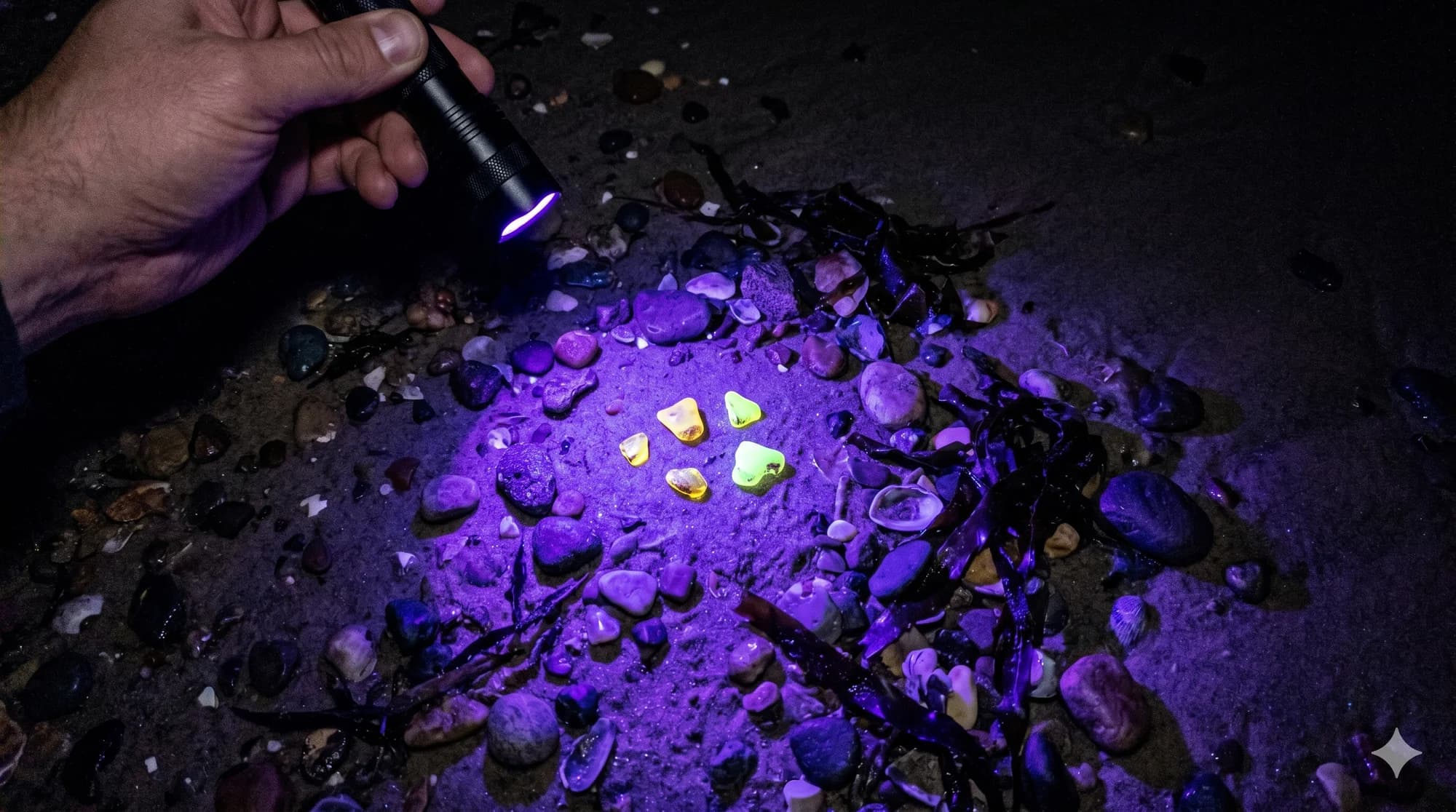
Baltic amber is the fossilised resin of ancient conifer forests that grew more than 40 million years ago. After a storm it washes ashore along the strandline — the band of seaweed, sticks and fine debris left at the tideline. The catch is that a freshly washed-up, wet piece can look just like an ordinary stone, a shard of glass or a lump of plastic.
The good news: real amber has a few traits that imitations can’t fake — it’s light, warm to the touch and glows under UV light. Below are quick tests for the field and at home, and at the end an important warning about white phosphorus — an amber lookalike that can cause severe burns.
Quick tests for amber
No single test is conclusive — it’s best to combine a few. Start with the ones that don’t damage the find.
- 1
Weight and touch
Pick the piece up. Amber is surprisingly light for its size and warms quickly in your hand — unlike stone or glass, which stay cold and heavy.[4]
- 2
UV torch
This is the best field test, especially after dark. Under a UV torch, real Baltic amber glows blue, turquoise or greenish. Plastic and glass usually don’t fluoresce, or glow a completely different colour.[4][5]
- 3
Salt-water test
Dissolve a few spoonfuls of salt in a glass of warm water until you have a strong brine. Real amber (density about 1.05–1.10 g/cm³) floats to the surface, while glass, stone and most plastics sink. Note: in plain water and in Baltic seawater amber sinks — it only floats in heavily salted water. The test isn’t foolproof: pressed amber (ambroid) and some imitations also float.[4]
- 4
Rub it: smell and static
Rub the piece briskly against wool. Once charged it will attract small bits of paper or hair — the Greek word for amber, «elektron», is the root of the word «electron». Warmed slightly by rubbing, real amber also gives off a faint resinous smell. Plastic smells chemical; glass has no smell at all.[4]
- 5
Softness (last resort)
Amber is soft — about 2–2.5 on the Mohs scale — so a blade will scratch it. Only ever do this on an inconspicuous edge of a doubtful piece: a scratch ruins a nice specimen, and copal (young resin) is softer still and can feel tacky.[4]
What real amber looks like
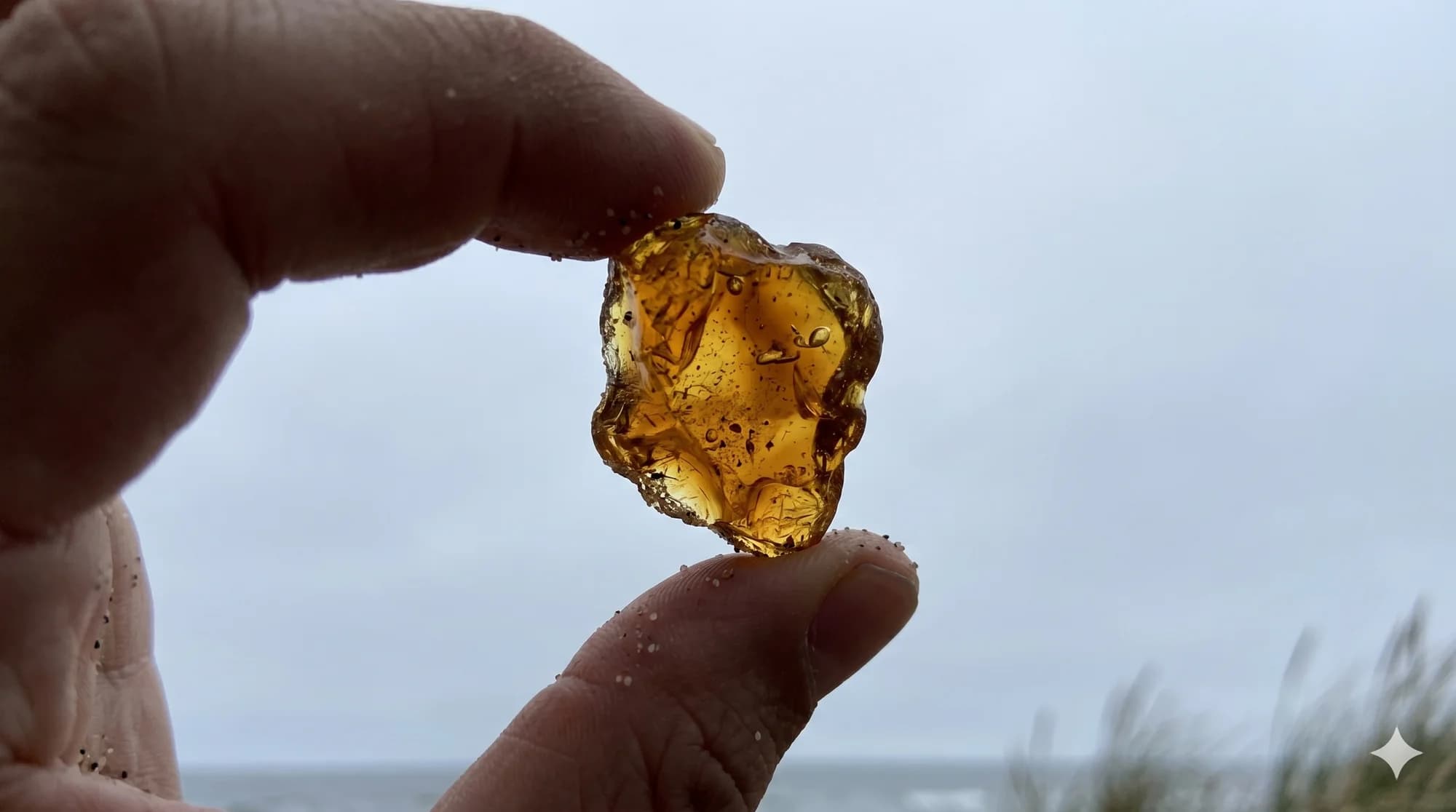
Baltic amber ranges from pale yellow through honey and orange to dark brown, and occasionally milky white. Freshly washed ashore it is often matte, with a weathered skin — only rubbing or polishing reveals the warm shine underneath.
It is light and warm to the touch, and often translucent when you hold it up to the light. Inside you can sometimes see inclusions — air bubbles, or trapped insects and bits of plant. Perfectly even, identical «insects» inside are a warning sign instead: that’s how cheap imitations are made.[4]
What amber is most often confused with
Stone and flint — heavy, cold, don’t glow under UV and don’t build up static when rubbed.
Glass — cold and hard, can’t be scratched by a blade, sinks in brine and has no smell when rubbed.[4]
Plastic and synthetic imitations — can be light, but smell chemical when warmed, usually don’t fluoresce the way amber does, and often have suspiciously regular «inclusions».[4]
Copal — a younger resin, similar to amber but clearly softer and more soluble; it softens and gets sticky faster when rubbed.[4]
⚠️ Warning: white phosphorus — amber’s dangerous lookalike
This is the most important part of this guide. Lumps of white phosphorus — residue from Second World War incendiary munitions dumped in the sea — wash up on southern Baltic beaches. Wet white phosphorus is a translucent, waxy solid that turns yellow in the light, which is exactly why beachcombers mistake it for amber and pick it up.[1][2] The German island of Usedom is the best-documented hotspot, but cases have occurred along the wider Baltic coast.[3]
The danger appears as the phosphorus dries out: in contact with air it can self-ignite at around 30°C, burns at up to roughly 1,300°C, and causes deep, slow-healing burns, while the fumes it gives off are toxic.[1][2] There have been several documented cases of beachcombers around the Baltic burned this way — in one, a person pocketed a «piece of amber» that then ignited and set their clothing alight.[3]
So: never put a find in your pocket or rucksack — that’s exactly when drying phosphorus ignites. If a «piece of amber» darkens, smokes, smells of garlic or grows warm for no reason as it dries, don’t touch it. Experts advise carrying any doubtful piece in a container of water (phosphorus is safe while wet), and if in doubt, leaving the find where it is and reporting it to the authorities. Phosphorus burning on skin can’t be wiped off — cool it with water and call the emergency services.[1]
See also
Frequently asked questions
Does amber float in seawater?
Does all amber glow under UV light?
How do I tell amber from white phosphorus?
Can amber be scratched?
Where is the best place to look for amber?
Sources
- Chemistry World (Royal Society of Chemistry) — “A dangerous guide to beachcombing” (white phosphorus mistaken for amber, self-ignition, safe handling) (retrieved: 2026-06-23)
- Umweltbundesamt (German Federal Environment Agency) — “Ammunition in the sea” (munitions and white phosphorus in the Baltic, burn temperature) (retrieved: 2026-06-23)
- The Local (Germany) — “‘Amber’ bomb bits set man’s pants on fire” (real beachcomber incident, white phosphorus from a WWII incendiary bomb) (retrieved: 2026-06-23)
- Muzeum Bursztynu (Amber Museum) — “How to recognise amber” (properties, salt-water test, UV, hardness) (retrieved: 2026-06-23)
- Manufaktura Bursztynu / Amber Museum, Kołobrzeg — “Amber and UV light: how real amber reacts” (retrieved: 2026-06-23)
We’ll tell you when amber starts washing up
Leave your email and we’ll let you know when conditions on the Baltic coast point to a good day for amber. Now and then we’ll add some AmberMap news.
See when to go to the beach
The AmberMap map shows the current amber forecast for the Baltic coast.
Open the mapOr browse beaches with a dedicated forecast.