Amber in Kołobrzeg
Kołobrzeg is one of the largest resorts on the Polish coast and a spa town with traditions reaching back to the 17th–18th century.[1] 12 km of sandy coastline, a harbour with five basins, a local Amber Museum and regular amber wash-ups after the autumn storms.
Current amber forecast for Kołobrzeg
Sign in to see today and tomorrow’s forecast; the full 10 days are available with Premium.
Forecast calculated: Saturday, 19 September 2026. AmberMap forecasting engine. Updated every 3 hours.
When to hunt for amber in Kołobrzeg
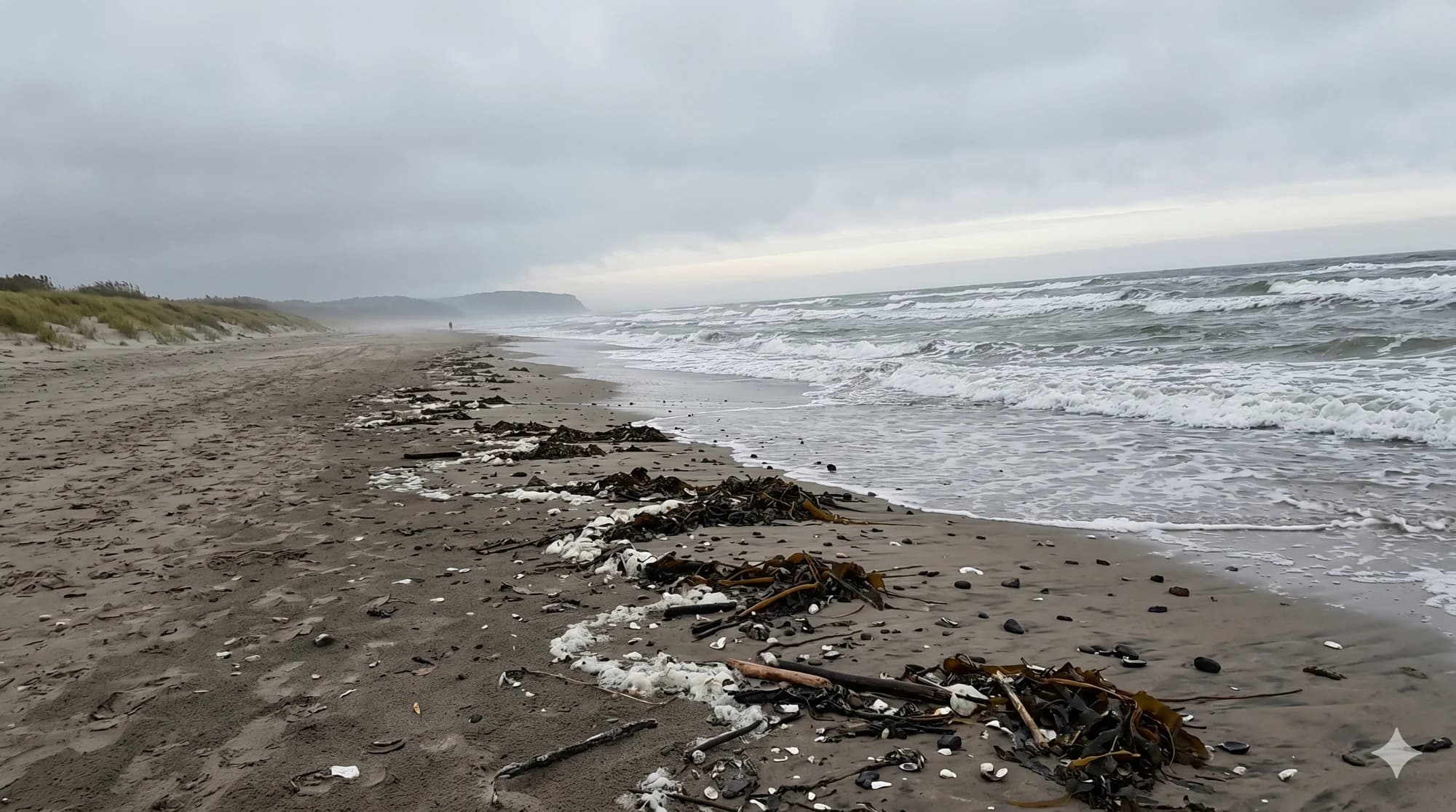
The amber season on the Baltic is late autumn and winter. That’s when the most storms pass over the Polish coast — IMGW (the Polish national weather service) records around 20–25 storm days per year, peaking in November, January and March.[2] Every storm tears amber off the seabed and throws it onto the shoreline together with seaweed and fine material.
For the western coast, where Kołobrzeg lies, the key winds come from the north (N) and north-west (NW) — these create the currents that move amber from the seabed to the beach most effectively.[3] A southerly or strongly easterly wind adds nothing useful.
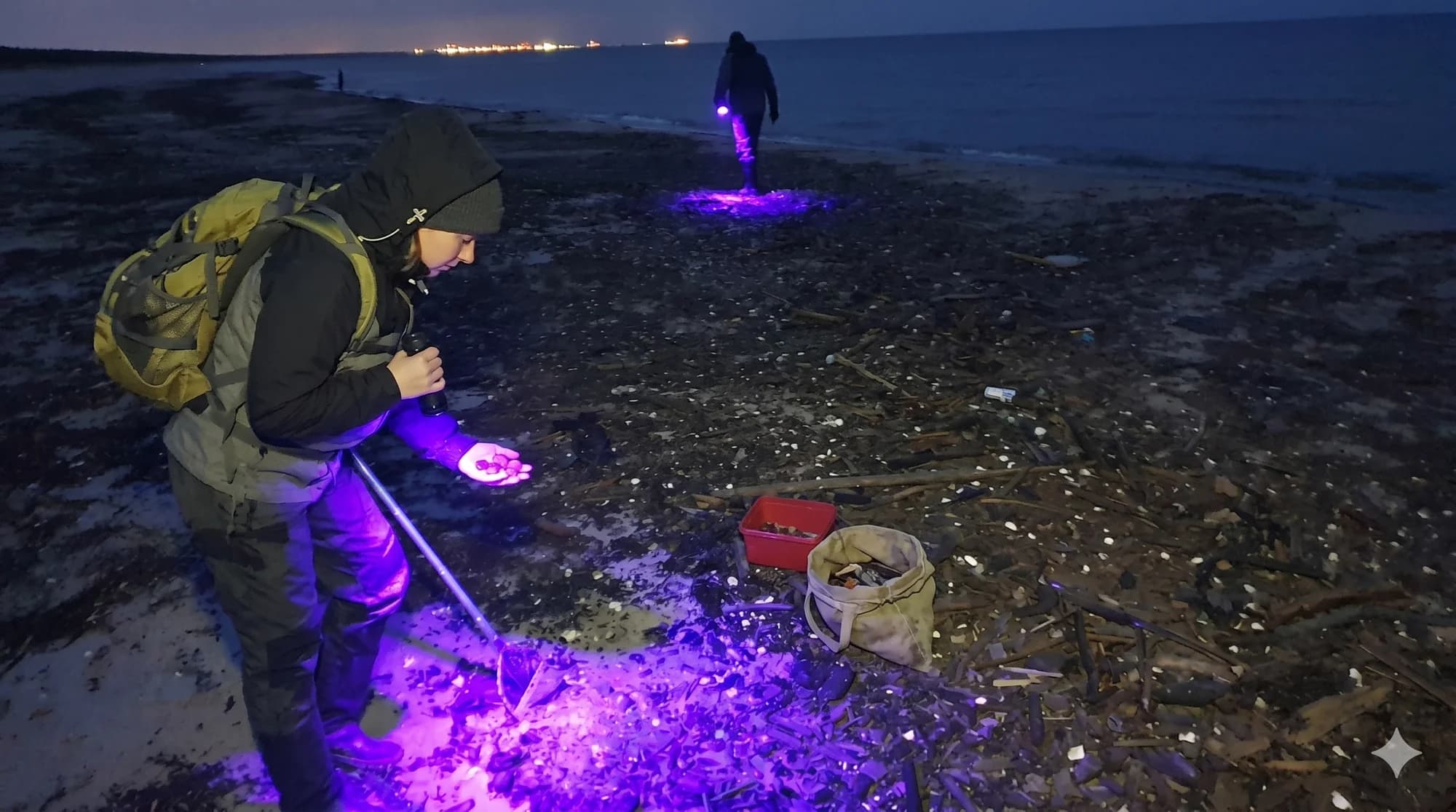
The best window is a few hours after a storm passes, when the waves are still dropping but fresh deposits are appearing on the shore. Kołobrzeg has 12 km of beaches within the town — from the main town beach to the longer stretches in Podczele and Bagicz on the eastern side. Choose a less crowded stretch — that improves your chances of hitting fresh finds.
Above this section you can see the current forecast for Kołobrzeg. Keep in mind: the forecast is most reliable within a 1–2 day horizon and loses precision further out, because the weather data itself becomes less accurate — that’s a limitation of meteorological models, not of our forecasting engine.
How to read the amber forecast for Kołobrzeg
The 0–100 score comes from the AmberMap forecasting engine and shows the chance of amber for a given hour. The colour scale is the same as on the map:
- 80–100 · Very good — Best moment — waves and wind are working in your favour.
- 60–79 · Good — A real chance of a successful search.
- 40–59 · Moderate — Decent conditions, but no guarantees.
- 20–39 · Low — Slim chances — more of a walk than a hunt.
- 0–19 · Unfavorable — No realistic chance under these conditions.
Estimated amber quantity
After signing in, each hour also shows an indicative amber-quantity range (in grams). The estimate depends on conditions and the beach's richness.
Safety warnings
- Ice danger — do not enter the water
- High waves — dangerous to wade in the water
- Inaccessible beach — beach flooded or inaccessible
Free — without logging in you see today’s forecast
Free registered account — today and tomorrow
How to get to Kołobrzeg
Kołobrzeg lies on the western coast, about 130 km west of Gdańsk and 140 km east of Świnoujście. The simplest route by car is the S6 expressway to the Kołobrzeg junction, then town roads straight to the centre.
By public transport: PKP Intercity trains run directly to Kołobrzeg from most of Poland’s major cities — it’s one of the largest seaside towns, with a well-developed network of connections. In summer there are extra seasonal trains.
The main harbour attraction is the sea port with five basins; the marina basin is a good place for a walk, and tourist cruises along the coast are often organised from here.[1]
Seasonal car parks are located in the town and by the beach access points. Prices and hours apply seasonally — check the signage on site.
Kołobrzeg as a spa town and amber hub
Kołobrzeg’s spa tradition reaches back to the 17th century — the town’s first sanatorium was founded in 1618, and in 1741 it formally gained spa-town status.[1] Since then Kołobrzeg has remained one of the largest resorts on the Polish Baltic, with numerous sanatoriums, hotels and rehabilitation centres offering brine baths, inhalations and massages.
The town is home to the Amber Museum in Kołobrzeg — a private institution presenting the history and culture of amber, with local specimens and the geological context of the Baltic.[1] A good stop on the way to the beach, especially on a rainy day.
All Baltic amber formed more than 40 million years ago from the resin of ancient coniferous forests. Poland’s largest collection can be seen at the Amber Museum in Gdańsk, housed in the Great Mill (Wielki Młyn).[4] The two institutions — the one in Gdańsk and the one in Kołobrzeg — complement each other: Gdańsk offers the full scale and historic masterpieces, Kołobrzeg the local context of the western coast.
Nearby beaches
Kołobrzeg lies in the middle of the western coast. The nearest surroundings:
- Mielno — to the east, a popular resort next to Lake Jamno
- Ustka — further east, the second-largest fishing port in this area→
- Międzyzdroje — further west, next to Woliński National Park
- Świnoujście — the western end of the Polish coast, the border with Germany
Frequently asked questions
When is the best time to hunt for amber in Kołobrzeg?
Does Kołobrzeg have its own Amber Museum?
Is the beach in Kołobrzeg long?
How do you recognise amber on the beach?
Can you keep amber found on the beach?
Is the AmberMap forecast for Kołobrzeg free?
Sources
- Kolobrzeg.eu — “History of the Spa” + Amber Museum Kołobrzeg (1618 first sanatorium, 1741 spa status, 12 km of beaches, harbour with 5 basins) (Polish-language source) (retrieved: 2026-05-05)
- IMGW-PIB — Baltic Service (storm statistics, hydrological warnings) (Polish-language source) (retrieved: 2026-05-05)
- Jakznalezc.pl — “How and where to find amber in Poland? A complete guide” (N/NW winds) (Polish-language source) (retrieved: 2026-05-05)
- Amber Museum — Museum of Gdańsk (the history of Baltic amber) (Polish-language source) (retrieved: 2026-05-05)
Check the forecast for your beach
See the map with the amber forecast for every region of the Polish Baltic coast.
Open the mapOr browse all beaches with a dedicated forecast.