Amber-hunting gear
You can pick amber off the beach with your bare hands, but to scoop it from the surf you’ll want the right kit. Here’s what’s actually worth having — and what you must not use.
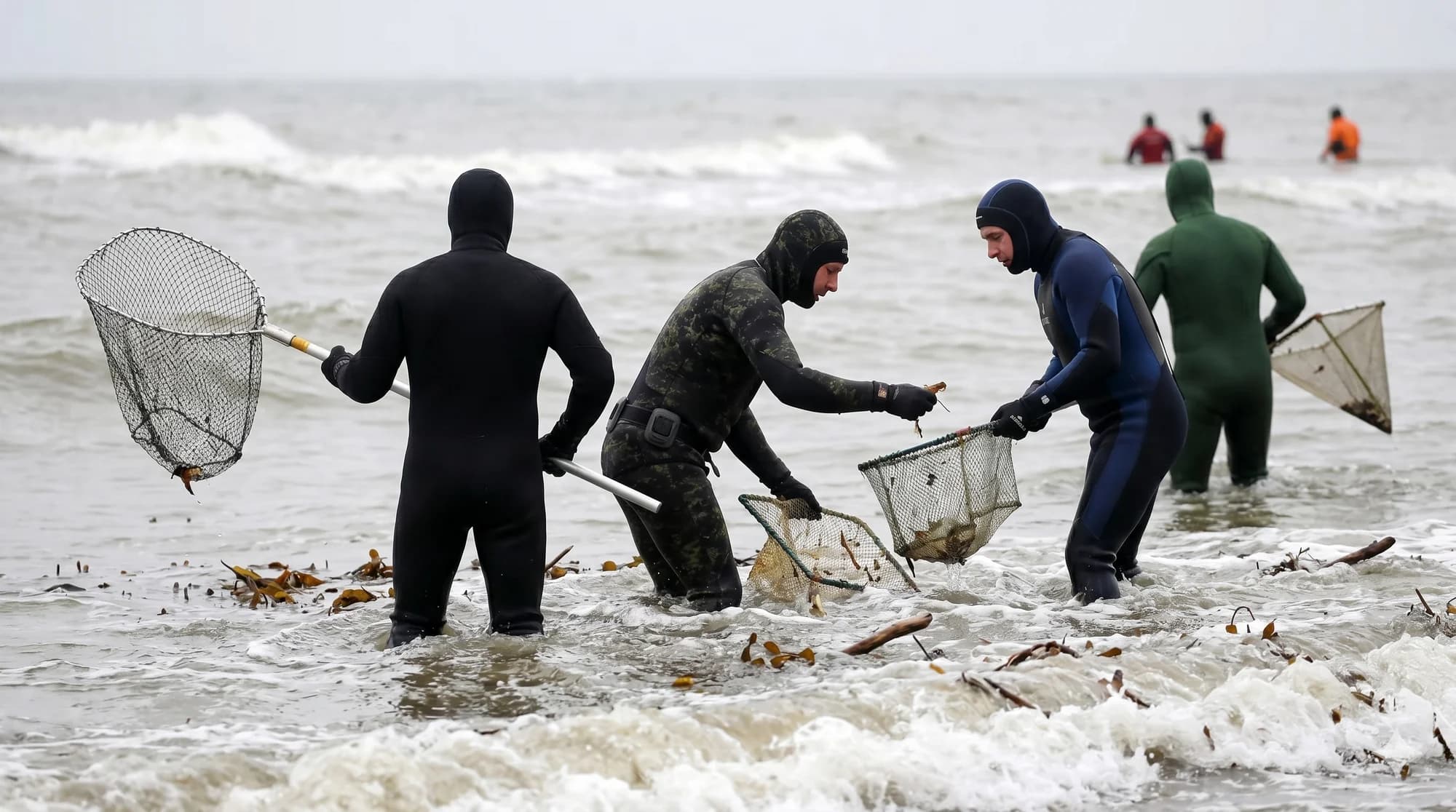
The simplest approach is to walk the shore and watch for amber in the strandline — for that you only need a sharp eye and a container for finds. But when you want to scoop amber straight from the waves, you need gear that protects you from the freezing water and makes lifting it out easier.
Below we run through the basics — from the net to a UV torch — and the rules many beginners don’t know about.
The net on a pole
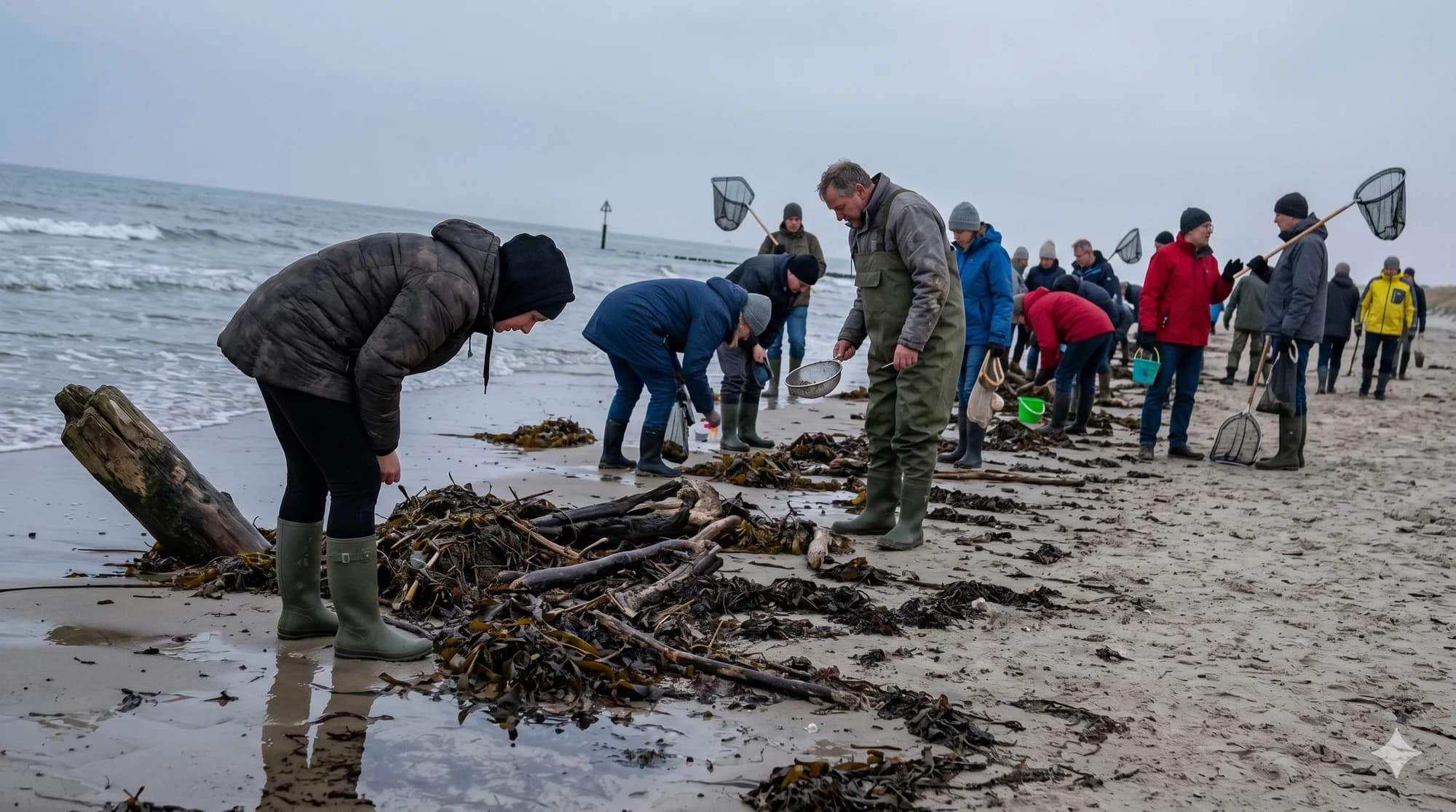
The classic tool is a long pole ending in a fine net — in Polish a «kaszorek». Hunters wade in with it and scoop up what floats on the waves and in the surf zone, gathering seaweed and light material with amber among it.[1]
A net like this lets you pick amber out of the water column while avoiding digging in the seabed. It’s a tradition most associated with the Polish coast, but the same wade-and-scoop technique is used elsewhere on the southern Baltic too.[1]
Waders and warm clothing
The Baltic during the storm season is freezing, and scooping means standing in the water. So hunters wear waders — high rubber trousers — with warm layers underneath and gloves.
This is gear for people who understand the risk: cold water, waves and a slippery bottom call for caution. Never go into a rough sea during a storm — wait until the waves drop.
A UV torch
A UV torch is one of the most effective ways to spot amber — under its light real amber fluoresces blue-green, while most imitations don’t.[2] It works especially well after dark: run it low over the strandline, moving the beam slowly.
Which wavelength? It depends on what you’re doing. To check dry pieces at home — and to tell amber from copal — a short 365 nm wavelength (usually with a ZWB2 filter) works best: it gives clean UV the eye can’t see, and strong contrast because it doesn’t add a violet glow.[3]
It’s different in the field, and especially when scooping from the water. There a higher range, around 395–420 nm, wins: these longer wavelengths, on the border of violet and near-UV, are absorbed far less by seawater — short 365 nm light is quickly soaked up by it. So strong lamps and head torches in this range let you spot amber floating in the waves from several metres away.
For more on how amber reacts under UV and which tests confirm it’s genuine, see our guide on how to identify amber.
What you must not use
Amber hunting has its limits, and the rules vary by country. In Poland, the amber collectors’ association (Stowarzyszenie Bursztynników) states that you may not use fishing nets, pumps or diving equipment to harvest amber.[1] Picking up amber washed ashore by the sea, and scooping it from the surf with a hand net, is the traditional, accepted practice; mechanical or diving extraction is a different matter.
In protected areas — national parks and reserves — extra restrictions apply almost everywhere on the Baltic, and other countries set their own rules. Before you go, it’s worth checking the local regulations for your stretch of coast.
See also
Frequently asked questions
Do I need a net to find amber?
Which UV torch for amber — what wavelength?
Can I scoop in the water in winter?
Am I allowed to use a net or a pump?
Sources
- Stowarzyszenie Bursztynników (Polish Amber Association, amber.org.pl) — “Amber fishing” (hand net, waders, rules on collection) (retrieved: 2026-06-23)
- Manufaktura Bursztynu / Amber Museum, Kołobrzeg — “Amber and UV light: how real amber reacts” (retrieved: 2026-06-23)
- SwiatloLux — “UV torches for amber hunting” (recommended wavelength, 365 vs 395 nm comparison) (retrieved: 2026-06-23)
We’ll tell you when amber starts washing up
Leave your email and we’ll let you know when conditions on the Baltic coast point to a good day for amber. Now and then we’ll add some AmberMap news.
See when to go to the beach
The AmberMap map shows the current amber forecast for the Baltic coast.
Open the mapOr browse beaches with a dedicated forecast.