Amber on Sobieszewo Island
Sobieszewo Island is a wild, 11-kilometre beach within the city limits of Gdańsk — running from the harbour at Świbno all the way to the Mewia Łacha nature reserve at the mouth of the Vistula.[1] After autumn and spring storms, amber appears here almost without fail.[2]
Current amber forecast for Sobieszewo Island
Sign in to see today and tomorrow’s forecast; the full 10 days are available with Premium.
Forecast calculated: Saturday, 19 September 2026. AmberMap forecasting engine. Updated every 3 hours.
When to hunt for amber on Sobieszewo Island
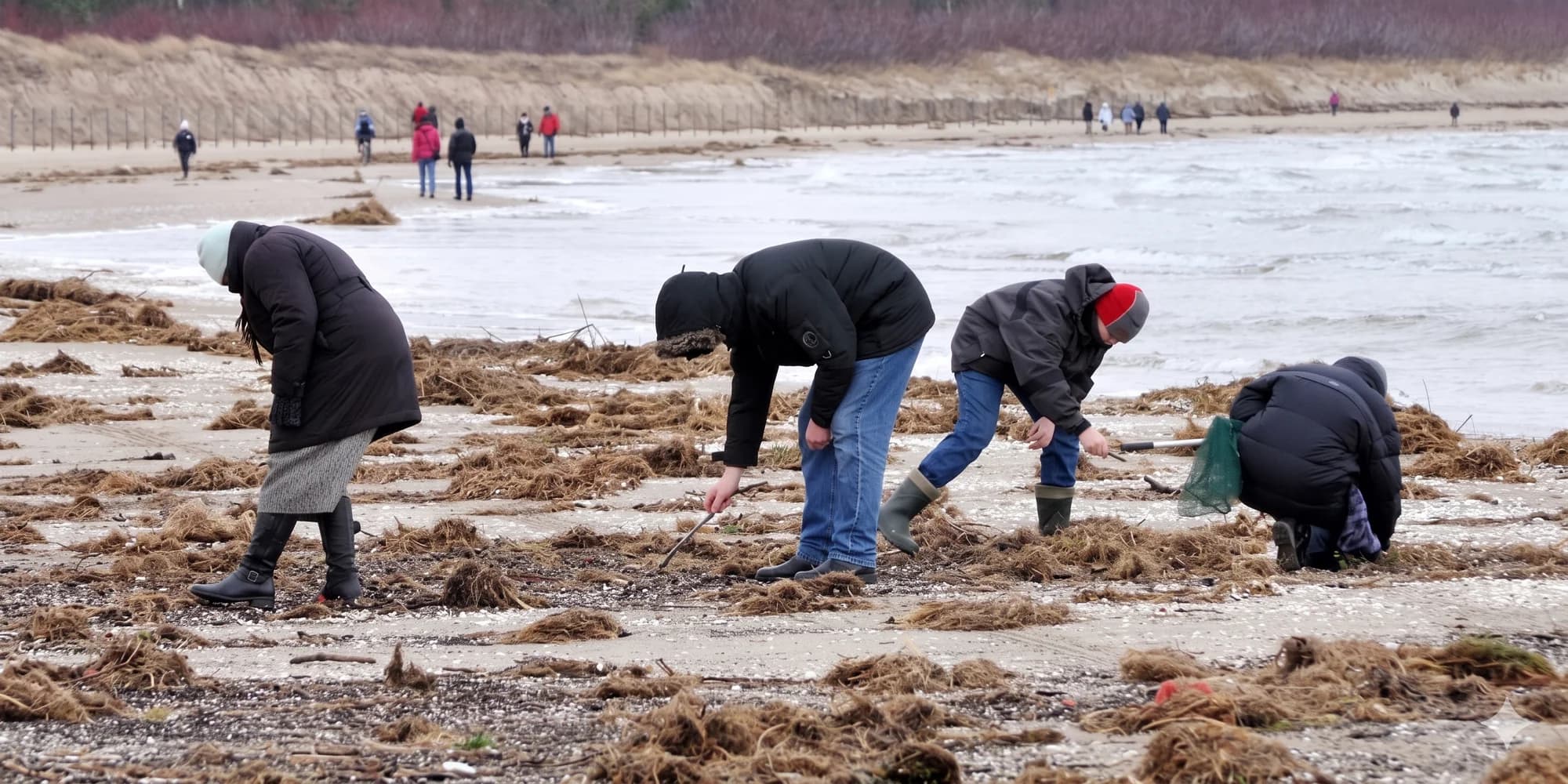
The amber season on the Baltic is late autumn and winter — that’s when the most storms pass over the Polish coast. The Polish national weather service (IMGW) records around 20–25 storm days per year, peaking in November, January and March.[3] Every storm tears amber off the seabed and throws it onto the shoreline together with seaweed and small twigs.
For Sobieszewo Island the key winds come from the north (N) and north-east (NE) — these create the nearshore currents that move amber from the seabed onto the beach most effectively.[4] A southerly or strongly westerly wind right at the mouth of the Vistula usually doesn’t help.
The best window is a few hours after a storm passes, when the waves are still dropping but fresh deposits of vegetation and fine material are appearing on the shore. Sobieszewo Island has two advantages: the 11-kilometre stretch of wild beach means more ground to comb through, and its partial-reserve status limits the number of visitors — so the beach is less often “picked over” before dawn.
Above this section you can see the current forecast for Sobieszewo Island. Keep in mind: the forecast is most reliable within a 1–2 day horizon and loses precision further out, because the weather data itself becomes less accurate — that’s a limitation of meteorological models, not of our forecasting engine.
How to read the amber forecast for Sobieszewo Island
The 0–100 score comes from the AmberMap forecasting engine and shows the chance of amber for a given hour. The colour scale is the same as on the map:
- 80–100 · Very good — Best moment — waves and wind are working in your favour.
- 60–79 · Good — A real chance of a successful search.
- 40–59 · Moderate — Decent conditions, but no guarantees.
- 20–39 · Low — Slim chances — more of a walk than a hunt.
- 0–19 · Unfavorable — No realistic chance under these conditions.
Estimated amber quantity
After signing in, each hour also shows an indicative amber-quantity range (in grams). The estimate depends on conditions and the beach's richness.
Safety warnings
- Ice danger — do not enter the water
- High waves — dangerous to wade in the water
- Inaccessible beach — beach flooded or inaccessible
Free — without logging in you see today’s forecast
Free registered account — today and tomorrow
How to get to Sobieszewo Island
Sobieszewo Island is a district of Gdańsk, lying between the Wisła Śmiała and the Wisła Przekop. The simplest route by car is the road from Gdańsk through Stogi and the bridges onto the island.
By public transport: Gdańsk ZTM bus lines 112, 122 or 186 connect the island with the centre of Gdańsk. In the summer season a bike is worth considering — the island is flat and the cycle paths run along the coast.
The ferry option: in the season from April to October a ferry runs across the Vistula between the harbour at Świbno (on the island) and Mikoszewo on the other side — this shortens the route to or from the Vistula Spit (Mierzeja Wiślana) by more than 20 km.
The Mewia Łacha reserve can only be visited along the marked educational and information trail — moving freely around the reserve area is prohibited.[1]
Sobieszewo Island and the mouth of the Vistula
Sobieszewo Island came into being when a new mouth of the Vistula was cut between Świbno and Mikoszewo in 1891–1895. Since then it has been separated from the rest of Gdańsk by two rivers and linked to the mainland by bridges and a seasonal ferry.
The Mewia Łacha nature reserve, established in 1991, protects one of the most ecologically valuable areas on the Polish Baltic. For the Arctic tern, the mouth of the Vistula is the only breeding site in Poland, and the beach and sandy bars at the river mouth are the first natural habitat of Baltic seals in the country.[1]
The beach on Sobieszewo Island is wild — wide, sandy, about 11 km long, and regularly strewn with pieces of amber after autumn and spring storms.[2] It is one of the best-preserved stretches of wild Polish beach, today within the city limits of Gdańsk.
All Baltic amber formed more than 40 million years ago from the resin of ancient coniferous forests. Poland’s largest collection can be seen at the Amber Museum in Gdańsk, housed in the Great Mill (Wielki Młyn) — a must-see stop after a trip to the island.[5]
Nearby beaches
Sobieszewo Island is a bridge between the Tri-City and the Vistula Spit. The closest surroundings:
- Mikoszewo — on the other side of the Vistula, reached by ferry from Świbno
- Stegna — the middle of the Vistula Spit, further east beyond Mikoszewo→
- Stogi (Gdańsk) — the neighbouring beach on the western side of the island, more urban in character
- Sopot — further west, the Tri-City and the other side of the Gulf of Gdańsk
Frequently asked questions
When is the best time to hunt for amber on Sobieszewo Island?
What is the Mewia Łacha reserve and can you go in?
What’s the fastest way to get here from the Vistula Spit?
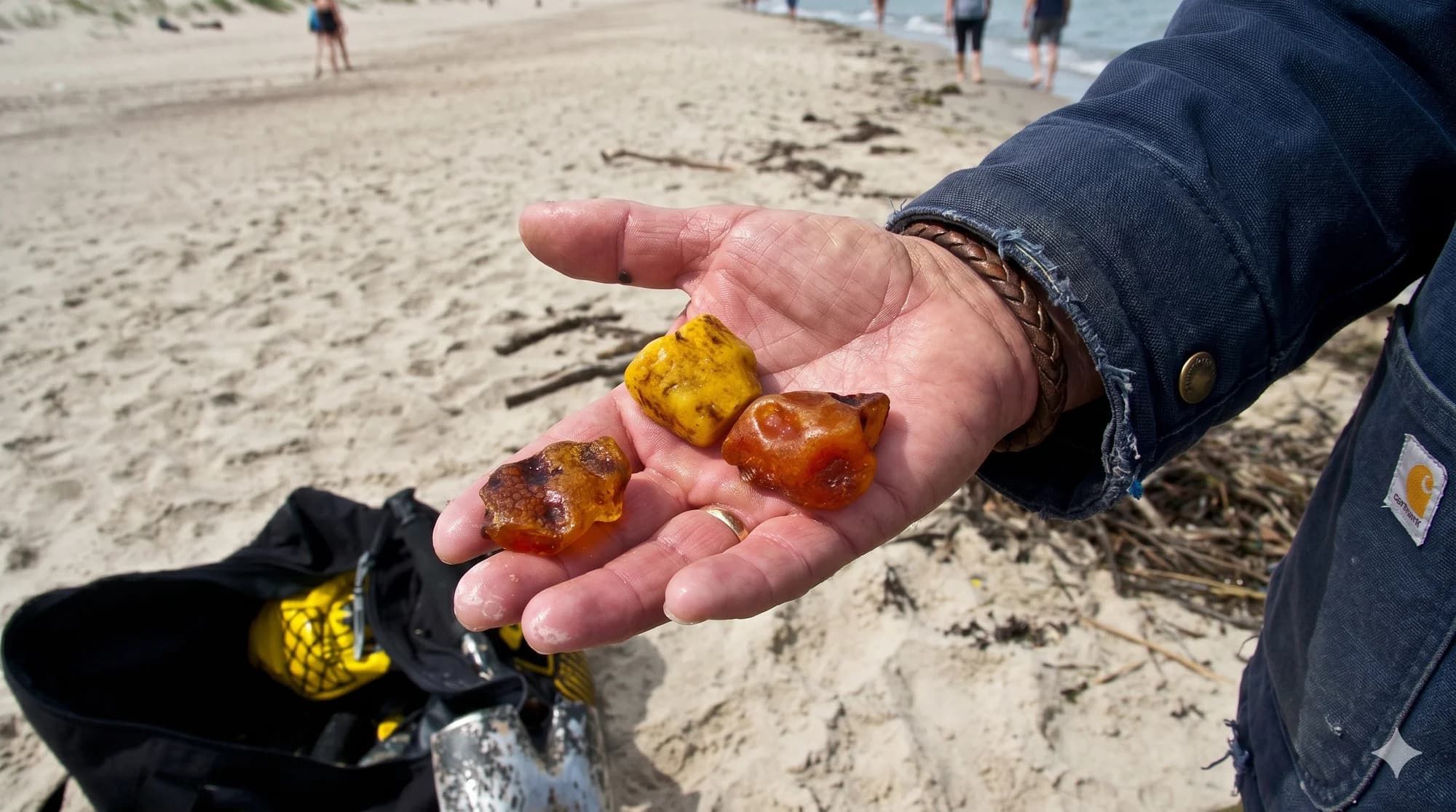
How do you recognise amber on the beach?
Can you keep amber found on the beach?
Is the AmberMap forecast for Sobieszewo Island free?
Sources
- Wyspa-sobieszewska.pl — “The Mewia Łacha reserve” (established 1991, bird protection, seal colony, educational trail) (Polish-language source) (retrieved: 2026-05-04)
- Bibaba.pl — “Where to find amber: Sobieszewo Island” (11-km wild beach, regular deposits after storms) (Polish-language source) (retrieved: 2026-05-04)
- IMGW-PIB — Baltic Service (storm statistics, hydrological warnings) (Polish-language source) (retrieved: 2026-05-04)
- Jakznalezc.pl — “How and where to find amber in Poland? A complete guide” (N/NE winds) (Polish-language source) (retrieved: 2026-05-04)
- Amber Museum — Museum of Gdańsk (the history of Baltic amber) (Polish-language source) (retrieved: 2026-05-04)
Check the forecast for your beach
See the map with the amber forecast for every region of the Polish Baltic coast.
Open the mapOr browse all beaches with a dedicated forecast.