Amber hunting at night with a UV torch
Under UV light amber glows blue-green, so at night it is easy to spot in the strandline and in the water. Torches in the 395–420 nm range work best, with 420 nm best in the water. Go after a storm, to a beach where the wind has been blowing straight onshore.
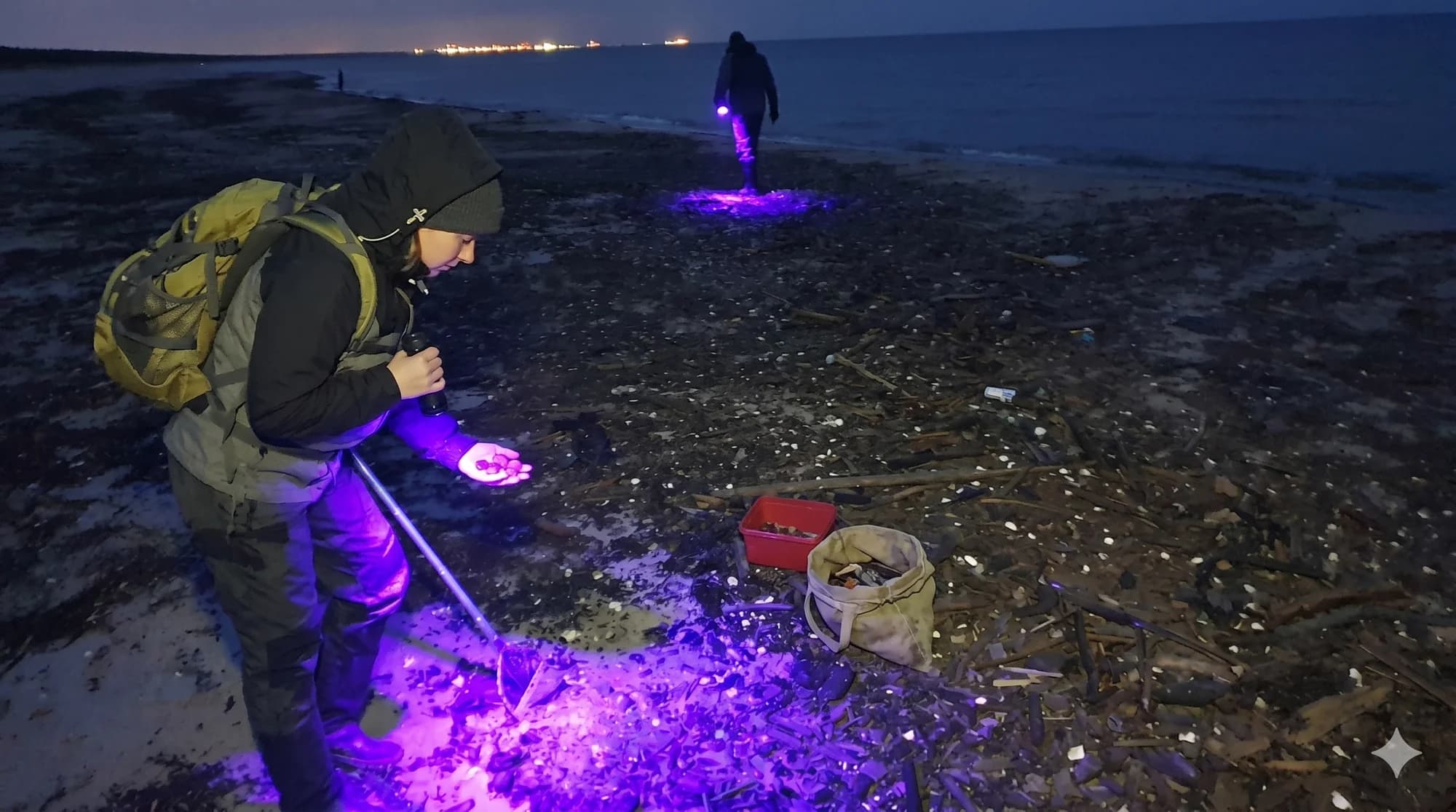
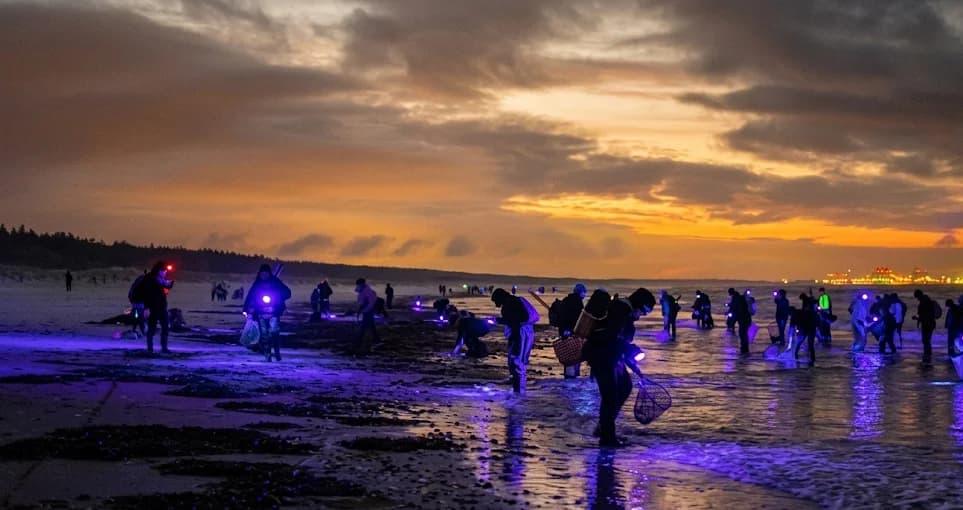
After a big storm on Poland’s Vistula Spit, one of the richest amber coasts on the Baltic, you can see a line of violet lights along the beach in the evening. Those are amber hunters with UV torches. Under ultraviolet light amber glows, while stones, shells and sticks stay dark. Small pieces you couldn’t tell from wet gravel by day can be seen from several metres away at night.
A torch makes searching easier, but it won’t put more amber on the beach. If the sea hasn’t washed anything up, nothing will glow under UV either. Hunters have more than once walked several beaches with a strong torch without finding a single small piece. So first you need to get the weather right; only then does the gear matter.
Night amber hunting step by step
The essentials in four steps. Details below.
- 1
Pick the right night
Your best chance of a find is after a storm, although that’s also when the competition is fiercest. Choose a beach where the wind has been blowing straight onshore, and go when the waves are starting to drop. Check where conditions are best on the forecast map.
- 2
Take a UV torch and an ordinary head torch
You search with the UV torch and use the head torch to light your way or take a closer look at a piece you’ve found. For amber, a torch in the 395–420 nm range works best. A spare battery, warm clothes, UV-protective glasses and a container for your finds are also useful.
- 3
Search the strandline and turn it over
Most amber lies where the strandline is full of small black twigs. Only what lies on top glows, so it pays to dig through the seaweed now and then.
- 4
Check what you pick up
Plastic, glass, string and paper can sometimes glow under UV too. Put your finds in a separate container, never loose in your pocket, because white phosphorus is easily mistaken for amber.
Why amber glows under UV
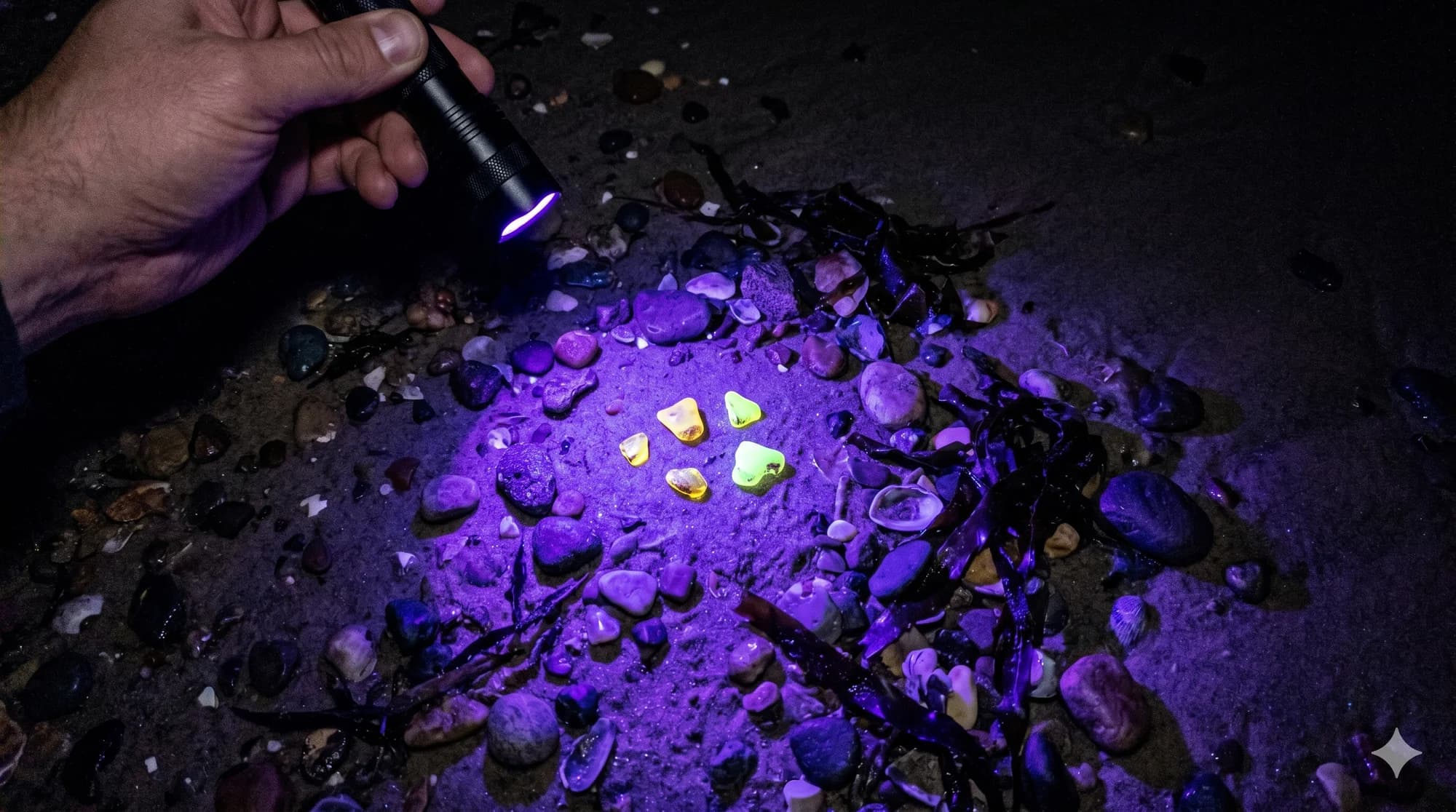
This is called fluorescence. Amber absorbs UV and re-emits it as visible light. Baltic amber usually glows blue, turquoise or greenish, and the shade and brightness vary from piece to piece. Plastic or glass can sometimes glow under UV too, so every find is worth a closer look. More on telling amber apart in our guide how to identify amber.
Amber only glows while the torch is shining on it and goes dark the moment you switch it off. The darker it is around you, the brighter it glows: in sunshine it is hard to see without a trained eye, while on a dark night even the tiniest bits show up.
Which UV torch for amber: 365, 395 or 420 nm?
For amber hunting, torches in the 395–420 nm range work best, and for spotting amber in the water 420 nm in particular. Common 365 nm torches will show amber too and are fine for casual hunting, but even the stronger ones light up only a small area, and the glow is weaker.
In the water there is one more factor. The Baltic contains a lot of dissolved organic matter washed in from the land by rivers (scientists call it CDOM, or yellow substance). According to research by the Institute of Oceanology of the Polish Academy of Sciences, it is the main absorber of light in Baltic waters, and the shorter the wavelength, the more strongly it absorbs. So 365 nm light fades much faster in the water than 420 nm. On a dry strandline this difference matters less, but when you are looking for amber in the surf or under a thin layer of water, it makes a big difference.
Power matters too. With a strong torch you’ll spot amber in the waves several metres ahead of you; with a weak one, only at your feet. Strong torches drain their batteries quickly, though, and even faster in frost. Charge your torch fully before you go out and carry a spare battery. It’s better to buy a 420 nm torch from a supplier of amber-hunting gear than to pick a random UV torch online.
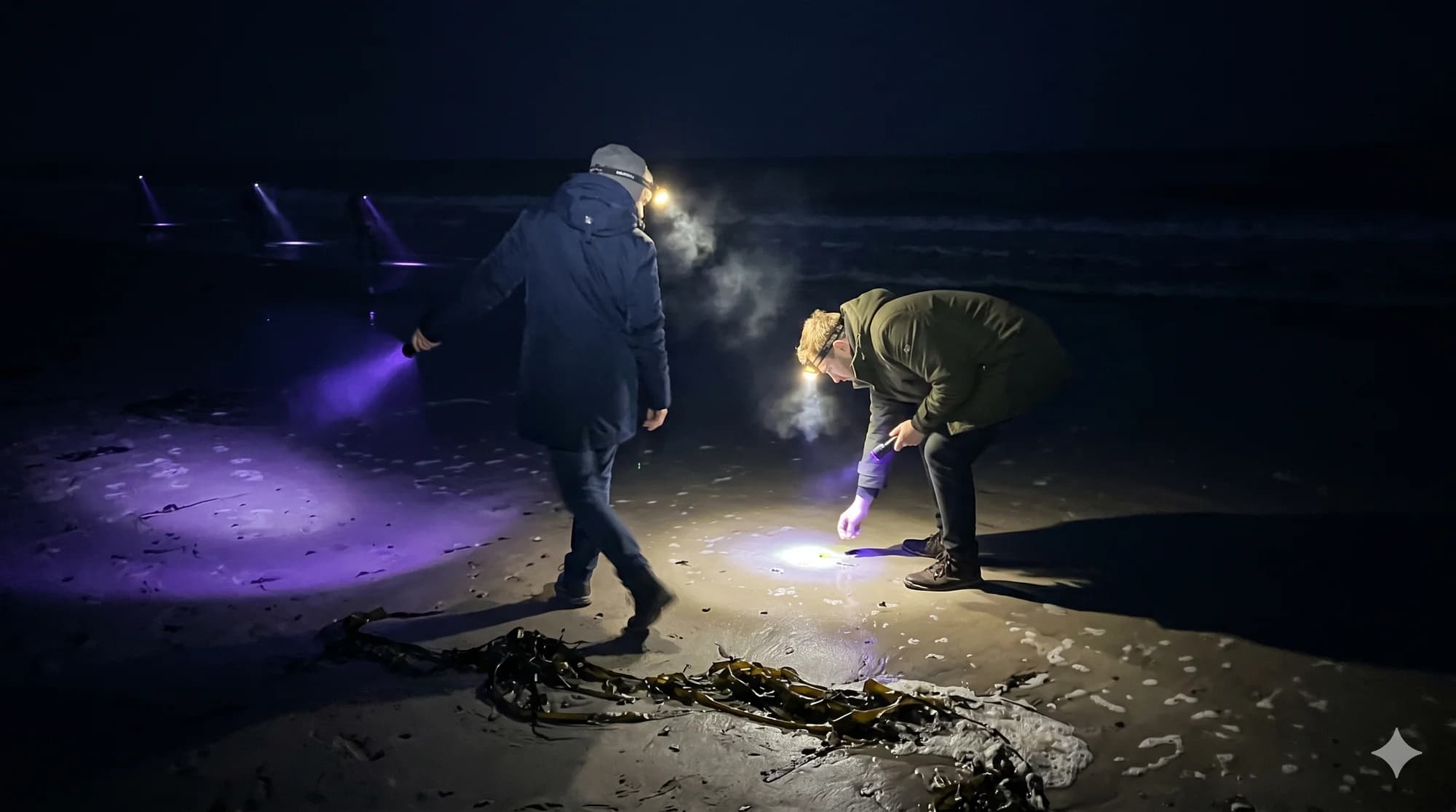
As well as the UV torch, bring an ordinary white head torch, because in violet light it’s hard to see where you’re walking. If you use a powerful UV torch, UV-protective glasses are a must; they often come with the torch. Never shine a UV torch into anyone’s eyes, including your own. The rest of the kit, including nets and waders, is covered in our guide to amber-hunting gear.
When to go out with a torch
The same as by day: after a storm, when the onshore wind eases and the waves start to drop, usually a few hours after the strongest wind. Wind direction matters too, because the best one differs from one stretch of coast to the next, depending on which way the beach faces. On Poland’s Vistula Spit it is a northerly (N), in Sopot and Gdynia an easterly to north-easterly (E–NE), and on the German island of Usedom a north-easterly (NE). For the Polish coast stretch by stretch, see our guide where to find amber in Poland.
From autumn to spring it gets dark early, so the best moment after a storm often falls after dusk. Without a torch you have to stop then; with one, you can keep going. An example from 12 January 2026 in Jantar, on the Vistula Spit: one hunter didn’t get to the beach until after 3.30 pm, searched into the evening and collected almost a kilogram, much of it after dark.
Remember that a lot of people hunt with torches these days. After a good storm, popular beaches on the Vistula Spit are often picked clean the very same night. In July 2026 one person who came to Jantar the day after such a night didn’t find a single small piece, and put it down to the “night-time torch frenzy” themselves. If you can, go the same evening, as the waves start to drop.
Night hunting is best treated as an extension of day hunting. By day it is easier to see where the sea has thrown up the most material and to spot bigger pieces. At night you find what is easy to miss by day: tiny bits and pieces mixed in with dark twigs. On 13 January 2025 another hunter on Sobieszewo Island in Gdańsk collected about 540 g during the day and then picked up about 70 g more with a UV torch in the evening.
Where to shine it: the strandline and the surf
Start with the strandline, the band of seaweed, twigs and wood left on the beach as the waves pull back. Amber is only slightly heavier than water and much lighter than sand, so the waves drop it together with wood and seaweed. Dense bands of small black twigs are a good sign. If the strandline is mostly shells, there is usually little amber. How to recognise a good strandline is covered in our guide amber after a storm.
Amber often lies under the seaweed, and a torch only shows what is on top. So turn the strandline over and shine again. In a thick, fresh strandline you’ll miss a lot if you don’t.
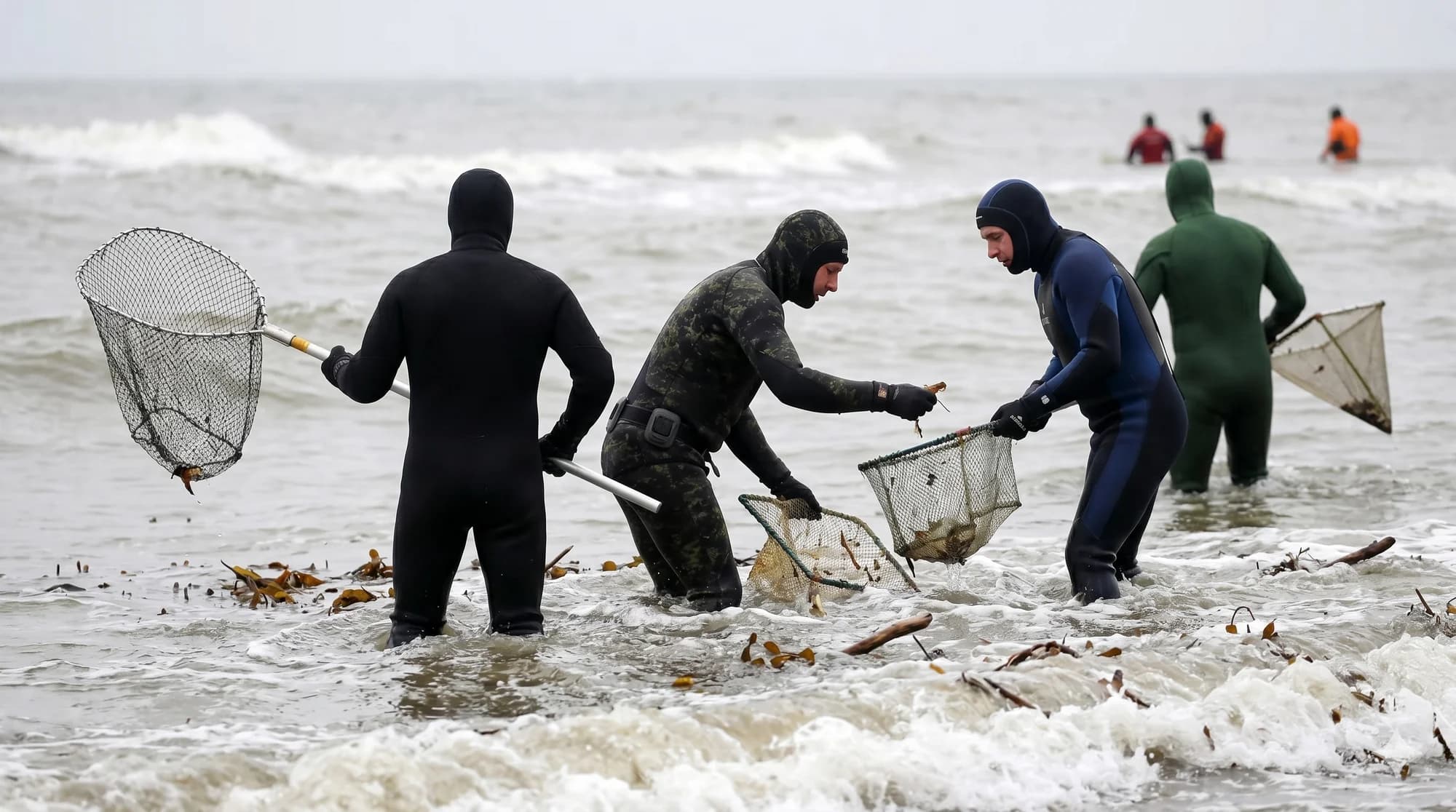
The second place is the water. As the waves start to drop, the sea keeps tossing material back and forth near the shore, and in the light of a strong 420 nm torch you can see glowing dots in the water and the foam. That’s the moment for a net and waders: you wade into shallow water, shine ahead of you and scoop out whatever glows. This is for experienced hunters, and not for the peak of a storm. In the dark it is harder to judge how big the waves are, and after a few hours they can build up again.
Most night-hunting reports come from the Vistula Spit in Poland, between Mikoszewo and Krynica Morska. But a UV torch works on any Baltic beach, as long as the sea has washed something up there.
What else glows under UV
On your first night out it’s easy to end up with a bag full of rubbish. Plastic, glass, string, bits of paper and fabric can sometimes glow under UV too. Some of them contain optical brighteners, compounds added to paper, plastics and washing powder which glow blue under ultraviolet light.
Pick up anything that glows and look at it in the ordinary light of your head torch. Amber is very light and warm to the touch, while plastic or paper is usually obvious at once from its shape and texture. If you’re not sure, keep the find and check it at home using the tests in our guide how to identify amber.
Watch out for white phosphorus
On beaches of the southern Baltic, the sea sometimes washes up white phosphorus from old munitions; the German island of Usedom is particularly known for it. It looks very much like amber. Once it dries, it ignites by itself and burns at over 1,000 °C. You can’t safely tell it apart from amber with a UV torch.
Never put finds loose in your pocket; use a metal container or a sieve. In a warm jacket pocket phosphorus can dry out and catch fire. If in doubt, leave the piece on the beach.
Staying safe at night
In the dark it is hard to judge how big the waves are, where the shallows end and where the stones are. A few simple rules:
• Don’t go into the water during a storm. With a net, go in only once the waves start to drop, and get out when they build again.
• In winter, watch out for icy beach access paths and an icy shoreline. Dress warmly: after a few hours in the wind it’s easy to get cold.
• Use a white head torch for walking and switch the UV torch on for searching.
• Don’t shine a UV torch into other people’s eyes, especially when a lot of people are searching nearby.
• Take a charged phone, ideally in a waterproof case.
Protected areas have their own rules, and they differ by country. In Poland, part of the Mewia Łacha reserve at the mouth of the Vistula is closed to walkers to protect birds. In Germany, restrictions apply in national parks, and in the Jasmund National Park on Rügen the beach below the chalk cliffs is risky because of rockfalls. Before you go, check the signs at the beach access.
Summary
A UV torch makes amber hunting much easier, especially for tiny bits and pieces in the water. A fully charged 395–420 nm torch (420 nm in the water) on a dark night after a storm works best.
Where and when the sea may wash amber ashore is shown on the AmberMap forecast map: day by day, for each region of the coast. During a storm and right after it, conditions change from hour to hour, so the Premium version has an hourly planner that shows when it’s worth heading out. A forecast doesn’t guarantee finds, but it helps you pick a night when going out makes sense.
See also
Frequently asked questions
What is the best UV torch for amber hunting?
Will a 365 nm UV torch work for amber?
What colour does amber glow under UV light?
When is the best time to hunt amber at night?
Is a UV torch useful during the day?
Is everything that glows under UV on the beach amber?
Can I hunt amber at night on any beach?
We’ll tell you when amber starts washing up
Leave your email and we’ll let you know when conditions on the Baltic coast point to a good day for amber. Now and then we’ll add some AmberMap news.
See when to go to the beach
The AmberMap map shows the current amber forecast for the Baltic coast.
Open the mapOr browse beaches with a dedicated forecast.