Why is there less amber in summer
Almost every collector has heard that “in summer the water is too warm and amber doesn’t float”. It’s a convenient explanation — and physically untrue. Here’s what really drives the season, with data from recent years.
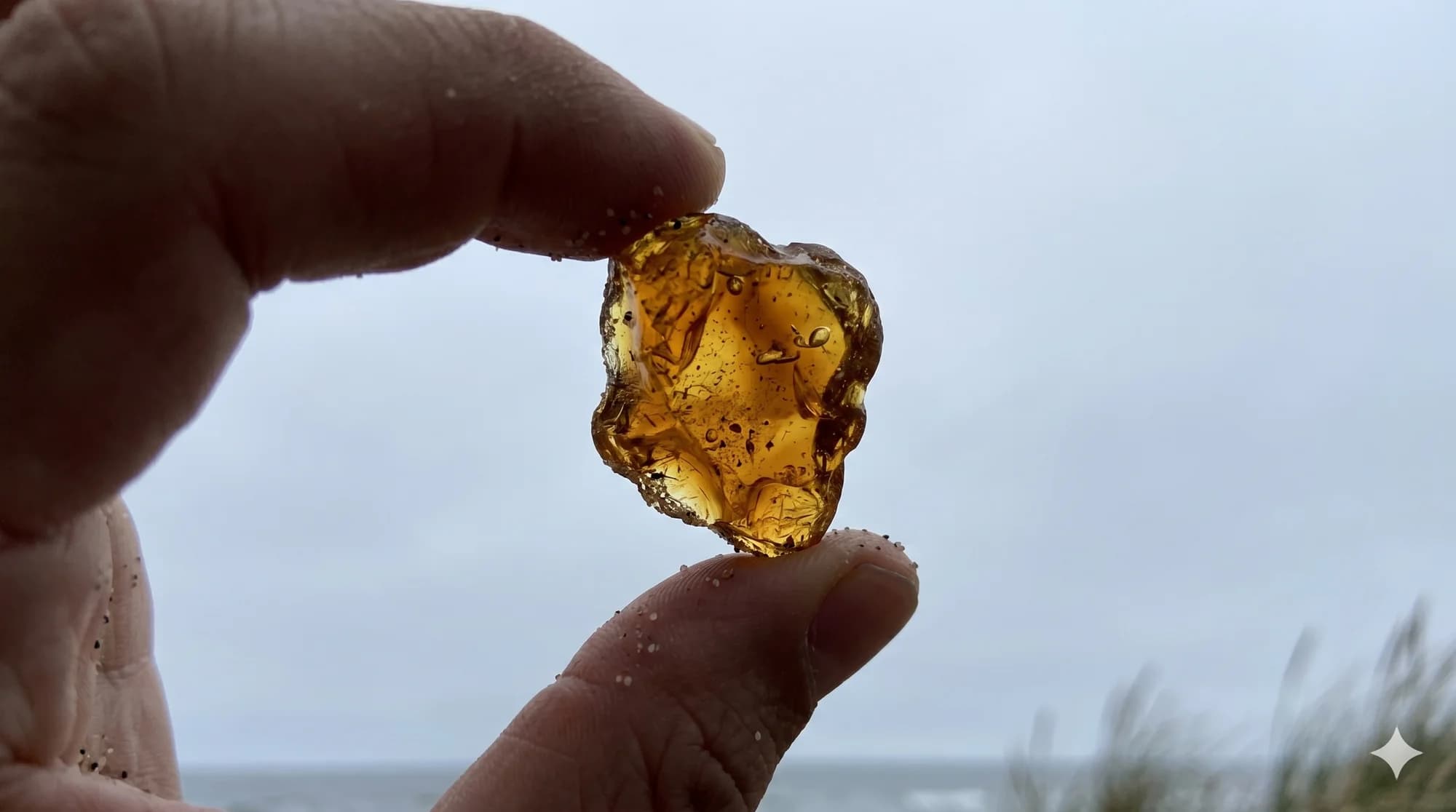
Let’s start by busting the most common myth. The belief goes that amber reaches the shore in winter because cold water is denser, and only then does amber start to float. It sounds reasonable — but the numbers don’t add up, and we’ll show them in a moment.
Amber is heavier than Baltic water all year round and sinks to the bottom in every season.[1] The season isn’t decided by “buoyancy”, but by how often the sea has enough energy to lift amber off the bottom and carry it to the beach. And that is, above all, a matter of storms — of which there are simply far more in winter.
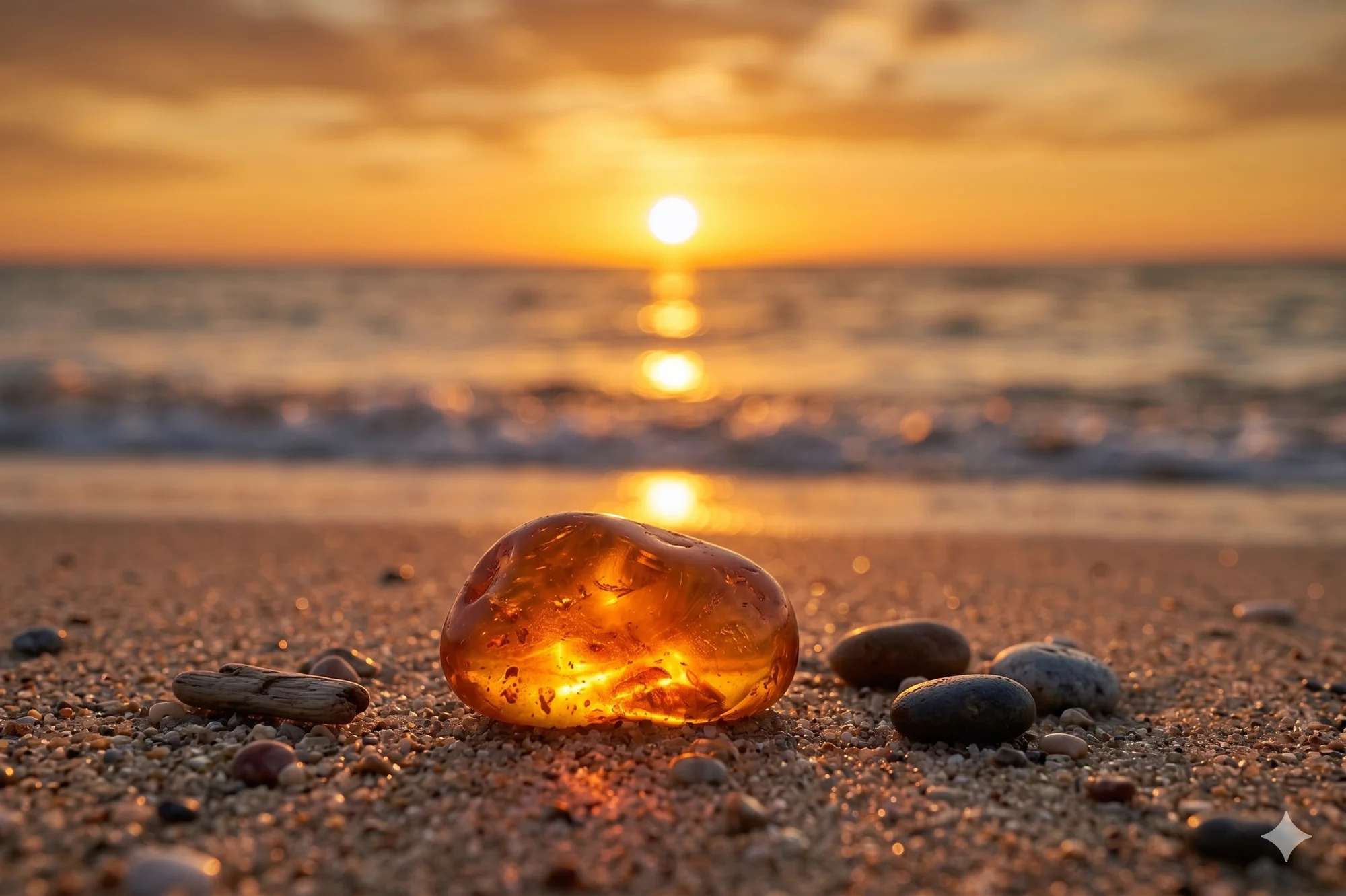
The myth: “in summer the water is too warm for amber to float”
Baltic amber has a density of about 1.05–1.10 g/cm³ — a few percent heavier than water.[1] Baltic water has a density of about 1.005 g/cm³ (it is only lightly salty, ~0.7% salt). The difference is 5–10%, and that is what settles it: in ordinary seawater amber sinks and lies on the bottom, regardless of the season.[1]
And temperature? Water density changes with it only minimally. From an icy 0 °C to a summery 25 °C, the density of Baltic water drops by just about 0.3%. That is dozens of times too little to “lift” amber that is a full 5–10% heavier. In other words: cooling the water does not switch on amber’s buoyancy — it sinks in December just as it does in July.
So where does the famous “salt test” come from? Amber really does float — but only in heavily over-salted water (a saturated salt solution has a density of about 1.2 g/cm³), which no sea has.[1] That’s why buoyancy is decided by salinity, not temperature — yet even the salty North Sea isn’t dense enough for amber to float in it: there too it sinks to the bottom, just as in the Baltic. One chart shows it best:
The real reason number one: storms
Amber reaches the beach on the waves — after storms that stir up the seabed and carry material ashore together with the strandline. And Baltic storms have a clear yearly rhythm: they are most frequent from late autumn to early spring, and almost absent in summer.[2]
We counted this using data from the last three full years (2023–2025) for the whole southern Baltic coast. Days with a really big storm — when the wave height exceeds 2 metres — line up like this:
Fewer storms = fewer chances
The conclusion is simple: if the sea churns several times more often in winter, it has several times more chances to throw amber ashore. In summer there can be weeks without a single proper storm — and that, not water temperature, is the main reason the beaches are “empty” then.
Independent data confirm it. According to IMGW, strong winds over the Baltic occur on average about 40 days a year, mostly in the cold half-year (September–March), and the mean wave height is markedly higher in winter and autumn than in spring and summer.[2] Our chart simply shows the same thing on a monthly scale.
Reason number two: in summer the sea stratifies
There is a second, less obvious cause — and here temperature really does matter, though in a completely different way than in the density myth. In summer the sun heats the top layer of the sea and a thermocline forms: a warm layer on top (a dozen-or-so metres) and cold water at the bottom, separated by a sharp boundary across which the temperature can drop by several to a dozen degrees within a few metres.[4]
Such a “lid” means the energy of wind and waves reaches the bottom less easily — and amber lies on the bottom. In autumn, as the water cools and storms mix the sea from surface to seabed, the thermocline disappears and the full force of the waves can again lift material off the bottom.[4] That is another reason the season falls in the cold months, not the warm ones.
Where temperature really does come into play: water viscosity
If you want a real link between temperature and amber, it’s not in density but in the viscosity of water. Cold water is “thicker” in the sense of a viscous fluid — more viscous, and holds suspended particles better. At the textbook extreme the difference is large: water near 0 °C is almost twice as viscous as 25 °C water.[3] The Baltic rarely reaches those extremes, though — at its realistic temperatures the difference is smaller.
What does that give us? In cold, viscous water, amber once lifted off the bottom settles more slowly and stays in the water column longer — the wave has more time to carry it toward shore before it settles again. In warm, “thin” water it sinks faster and more often settles back near the bottom before reaching the beach. At realistic Baltic temperatures (about 4 °C in winter, about 19 °C in summer) cold water is roughly 1.5× more viscous — a smaller effect than the storms, but a real one, working in the same direction.
What this means for the collector
First: don’t wait for the “right water temperature” — it isn’t what decides. The weather decides. Second: amber does turn up in summer too, just less often — after every bigger, windy change in the weather it’s worth checking the beach, whatever the season.
There’s also a purely human reason, unrelated to physics. Summer is the peak season on the Baltic coast — there are far more people on the beaches than in the empty, cold months. So the little amber the sea does throw up in summer is scanned by many more hands, and the strandline is often picked over before you even get to it. Less amber and more searchers at once — that adds to the feeling that the beach is “cleaned out” in summer. But it’s only a supplement to the main cause: the weather, not the water temperature.
The most chances, though, come in the autumn–winter season: more frequent and stronger storms, a sea mixed all the way to the bottom and more viscous water together mean that this is when amber most often reaches the shore. You can check the current amber chance for your stretch of coast on the AmberMap map.
See also
Frequently asked questions
Is it true that amber only floats in cold water?
So why is there more amber in winter?
Is there no amber at all in summer?
What’s the difference between water density and viscosity?
Is amber harder to find in summer partly because there are more people?
Sources
- Manufaktura Bursztynu / Amber Museum in Kołobrzeg — “Physical properties of amber: hardness, density and structure” (in Polish) (retrieved: 2026-06-26)
- IMGW-PIB / Obserwator — “High waves on the Baltic Sea” (seasonality of Baltic storms and waves) (retrieved: 2026-06-26)
- The Engineering ToolBox — “Water - Dynamic and Kinematic Viscosity” (water viscosity vs temperature) (retrieved: 2026-06-26)
- Finnish Meteorological Institute — “Stratification of the Baltic Sea” (thermocline, summer stratification) (retrieved: 2026-06-26)
- Copernicus Marine Service / ECMWF — Baltic Sea wave and wind reanalysis data (source of the storm chart) (retrieved: 2026-06-26)
We’ll tell you when amber starts washing up
Leave your email and we’ll let you know when conditions on the Baltic coast point to a good day for amber. Now and then we’ll add some AmberMap news.
See when to go to the beach
The AmberMap map shows the current amber forecast for the Baltic coast.
Open the mapOr browse beaches with a dedicated forecast.