Amber in Krynica Morska
Krynica Morska is the eastern end of the Vistula Spit (Mierzeja Wiślana) and one of the smallest towns in Poland.[1] It is home to the only working lighthouse on the entire Spit, and its sandy beaches set in pine forest are among the most beautiful in this part of Europe.[1]
Current amber forecast for Krynica Morska
Sign in to see today and tomorrow’s forecast; the full 10 days are available with Premium.
Forecast calculated: Saturday, 19 September 2026. AmberMap forecasting engine. Updated every 3 hours.
When to hunt for amber in Krynica Morska
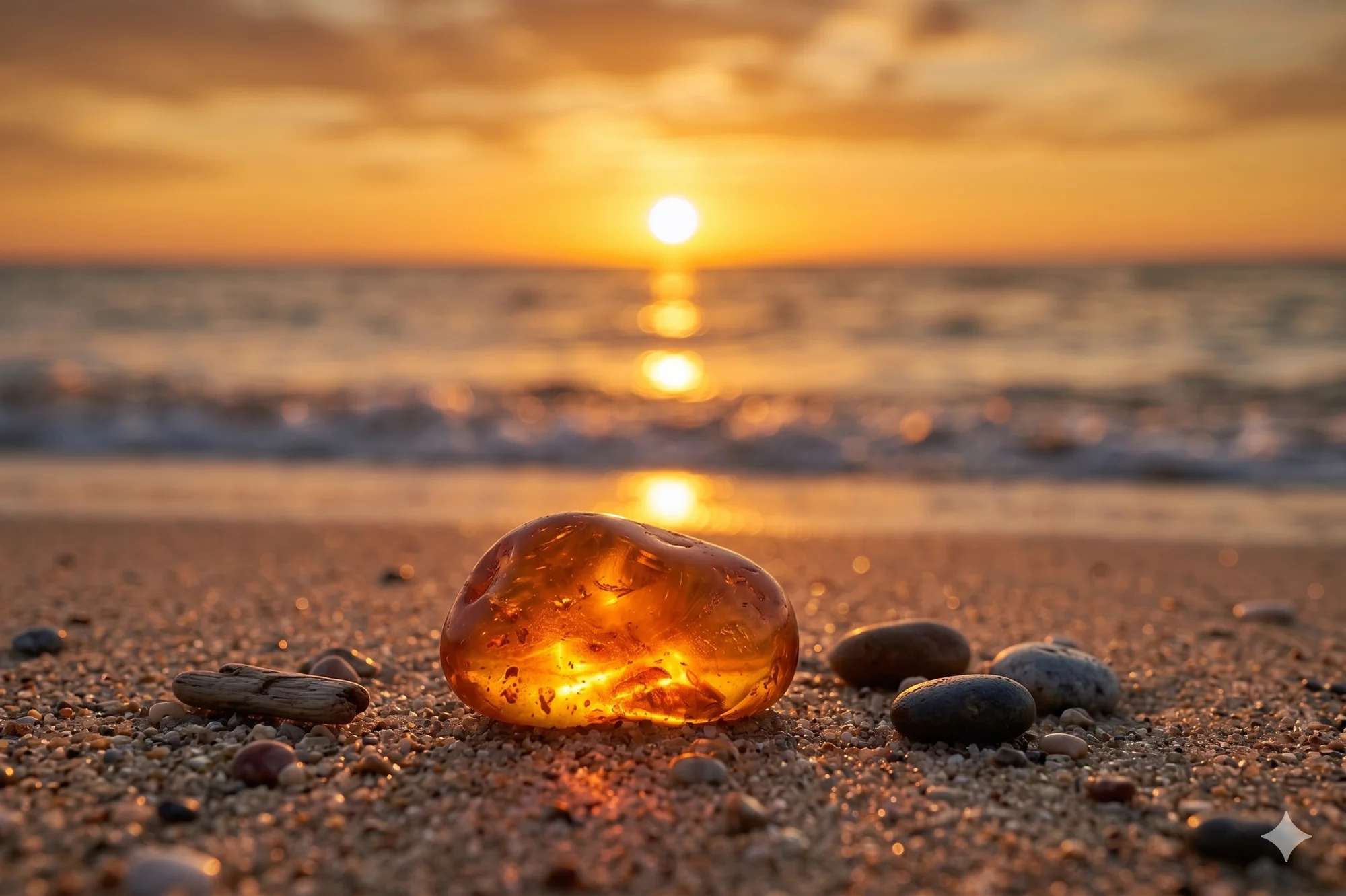
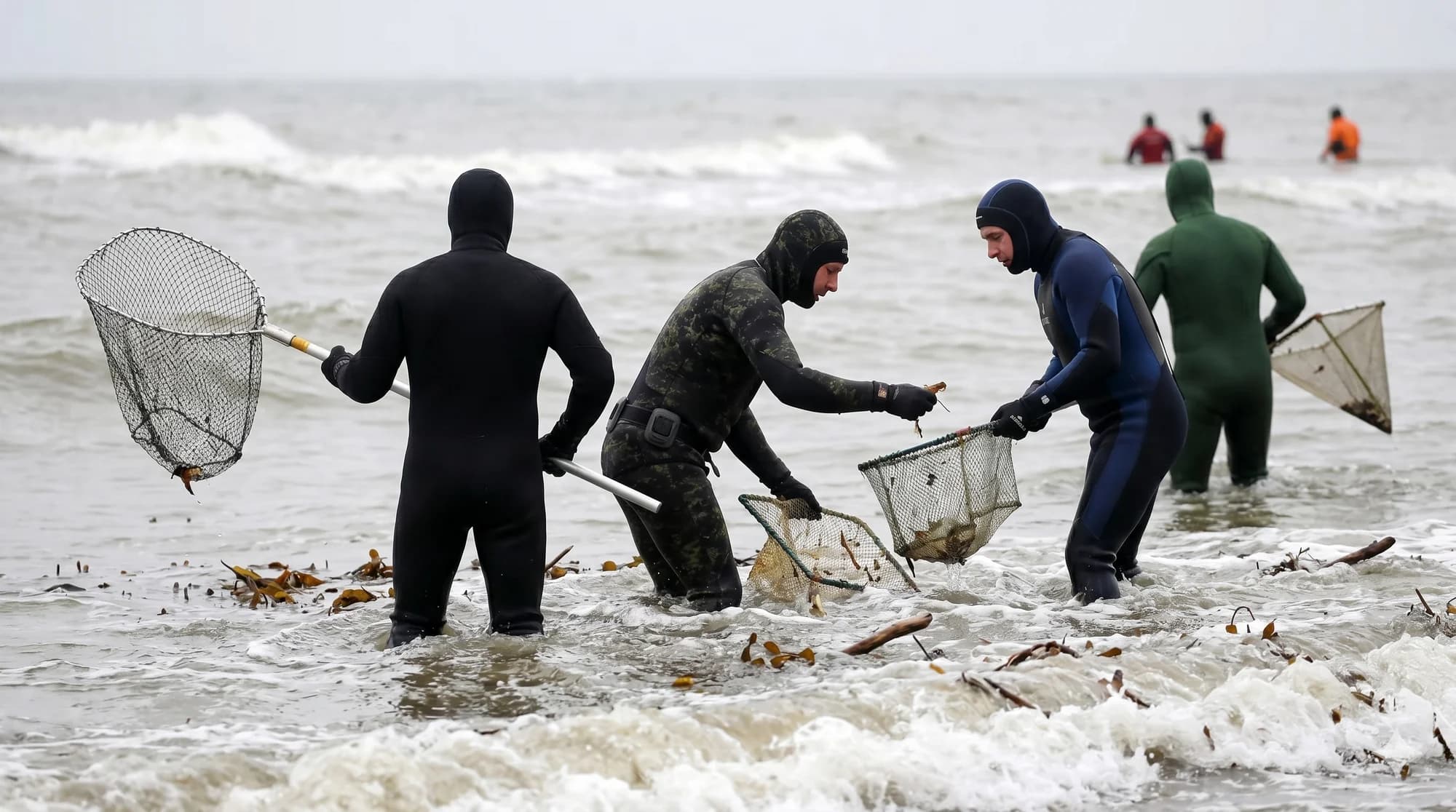
The amber season on the Baltic runs from late autumn through winter. That’s when the most storms pass over the Polish coast — IMGW (the Polish national weather service) records roughly 20–25 storm days a year, peaking in November, January and March.[3] Each storm tears amber loose from the seabed and casts it ashore along with seagrass and seaweed on the shoreline.
For the eastern end of the Spit (Krynica Morska and neighbouring Piaski), the key winds blow from the north-west (NW) and the north (N) — these create the currents that move amber from the seabed to the beach most effectively. The AmberMap engine (Jurata v6) treats these directions as the most favourable for the eastern end of the Spit — the window shifts towards NW here compared with the more westerly beaches of the peninsula. A southerly or easterly wind won’t help.
The best window is a few hours after a storm passes, when the waves are still easing but fresh casts appear on the shore. Krynica Morska is smaller than Stegna and Jantar, so the beach is combed over less often at dawn — winter brings extra calm, since there are few tourists.
Above this page you can see the current forecast for Krynica Morska. Remember: the forecast is most reliable within a 1–2 day horizon and loses precision further out, because the weather data itself becomes less accurate — that’s a limitation of meteorological models, not of our forecasting engine.
How to read the amber forecast for Krynica Morska
The 0–100 score comes from the AmberMap forecasting engine and shows the chance of amber for a given hour. The colour scale is the same as on the map:
- 80–100 · Very good — Best moment — waves and wind are working in your favour.
- 60–79 · Good — A real chance of a successful search.
- 40–59 · Moderate — Decent conditions, but no guarantees.
- 20–39 · Low — Slim chances — more of a walk than a hunt.
- 0–19 · Unfavorable — No realistic chance under these conditions.
Estimated amber quantity
After signing in, each hour also shows an indicative amber-quantity range (in grams). The estimate depends on conditions and the beach's richness.
Safety warnings
- Ice danger — do not enter the water
- High waves — dangerous to wade in the water
- Inaccessible beach — beach flooded or inaccessible
Free — without logging in you see today’s forecast
Free registered account — today and tomorrow
How to get to Krynica Morska
Krynica Morska lies at the eastern end of the Vistula Spit, about 75 km from Gdańsk. The simplest route by car is national road no. 7 (S7) to the Koszwały junction, then provincial roads 501 and 502 through Stegna and Sztutowo.
By public transport: take the SKM commuter rail or PKP to Gdańsk Główny, then a bus to Krynica Morska. In the summer season extra tourist services run — check the current timetable with the carrier.
In summer there is also a ferry crossing over the Vistula Lagoon — from Frombork or other ports on the Lagoon — which is an attraction in its own right and an alternative to the congested road 501.
Seasonal car parks are located by the beach access points and in the centre. Prices and hours apply seasonally — check the signage on site.
Krynica Morska and the Camel’s Hump
Krynica Morska is formally a town, but one of the smallest in Poland by population. Its sandy beaches, dense pine forests and iodine-rich air draw thousands of tourists.[1]
The Krynica Morska lighthouse is the only working lighthouse on the entire Vistula Spit. It stands 26.5 m tall — one of the highest points in the area. 105 steps lead to the top, from where you can see the Baltic Sea, the Bay of Gdańsk, the Vistula Lagoon and Frombork.[1]
The Camel’s Hump (Wielbłądzi Garb) is the highest natural point on the Vistula Spit and the only spot on the peninsula from which you can see both the Bay of Gdańsk and the Vistula Lagoon at the same time.[1] A short walk from the beach, it’s a good place for an afternoon reset between amber-hunting sessions.
All Baltic amber formed more than 40 million years ago from the resin of ancient coniferous forests. Poland’s largest collection can be seen at the Amber Museum in Gdańsk, housed in the Great Mill.[4]
Nearby beaches
The whole Vistula Spit is one amber trail. If the conditions in Krynica Morska don’t pan out, check the neighbouring stretches:
- Sztutowo — the western neighbour, the central stretch of the Spit
- Stegna — the middle of the Spit, organiser of the Championships→
- Jantar — the final-round beach of the World Amber-Panning Championships→
- Mikoszewo — the western end of the Spit, by the Vistula Cut
Frequently asked questions
When is the best time to hunt for amber in Krynica Morska?
Is it worth climbing the lighthouse?
What is the Camel’s Hump?
How do you recognise amber on the beach?
Can you keep amber found on the beach?
Is the AmberMap forecast for Krynica Morska free?
Sources
- Bartekwpodrozy.pl — “The Vistula Spit: 20 attractions” (lighthouse, the Camel’s Hump, beaches, the character of Krynica Morska) (Polish-language source) (retrieved: 2026-05-05)
- Jakznalezc.pl — “How and where to find amber in Poland? A complete guide” (the Vistula Spit — geographic context and the tradition of amber hunting) (Polish-language source) (retrieved: 2026-05-05)
- IMGW-PIB — Baltic Service (storm statistics, hydrological warnings) (Polish-language source) (retrieved: 2026-05-05)
- Amber Museum — Museum of Gdańsk (the history of Baltic amber) (Polish-language source) (retrieved: 2026-05-05)
Check the forecast for your beach
See the map with the amber forecast for every region of the Polish Baltic coast.
Open the mapOr browse all beaches with a dedicated forecast.